
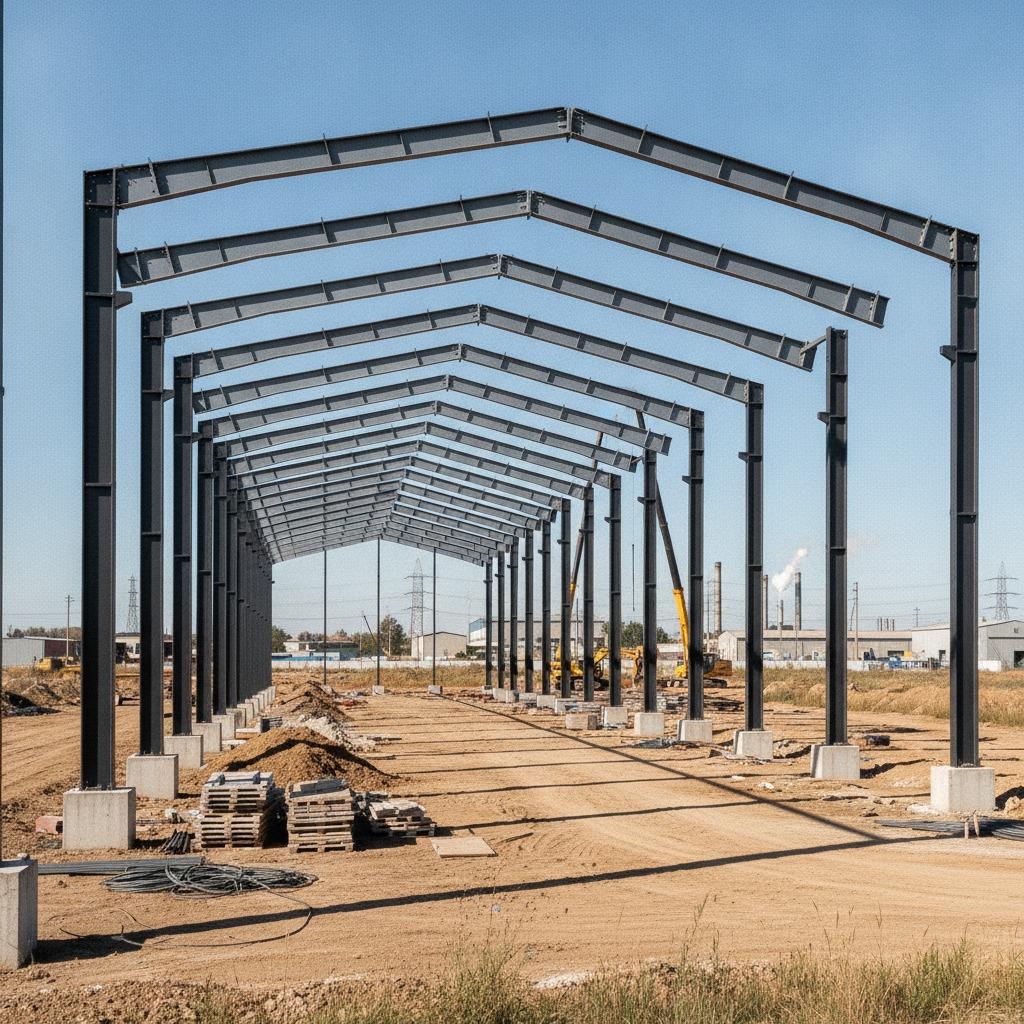
What a steel structure is really buying you
A steel structure is rarely just “the frame.” For most industrial projects, it is the decision that determines how much open space you get, how quickly the building can go up, and how much future flexibility you keep when the operation changes. In a warehouse, workshop, or factory building, the frame is the quiet piece doing most of the work: carrying the roof, setting the bay layout, and giving the enclosure its shape before a single wall panel is installed.
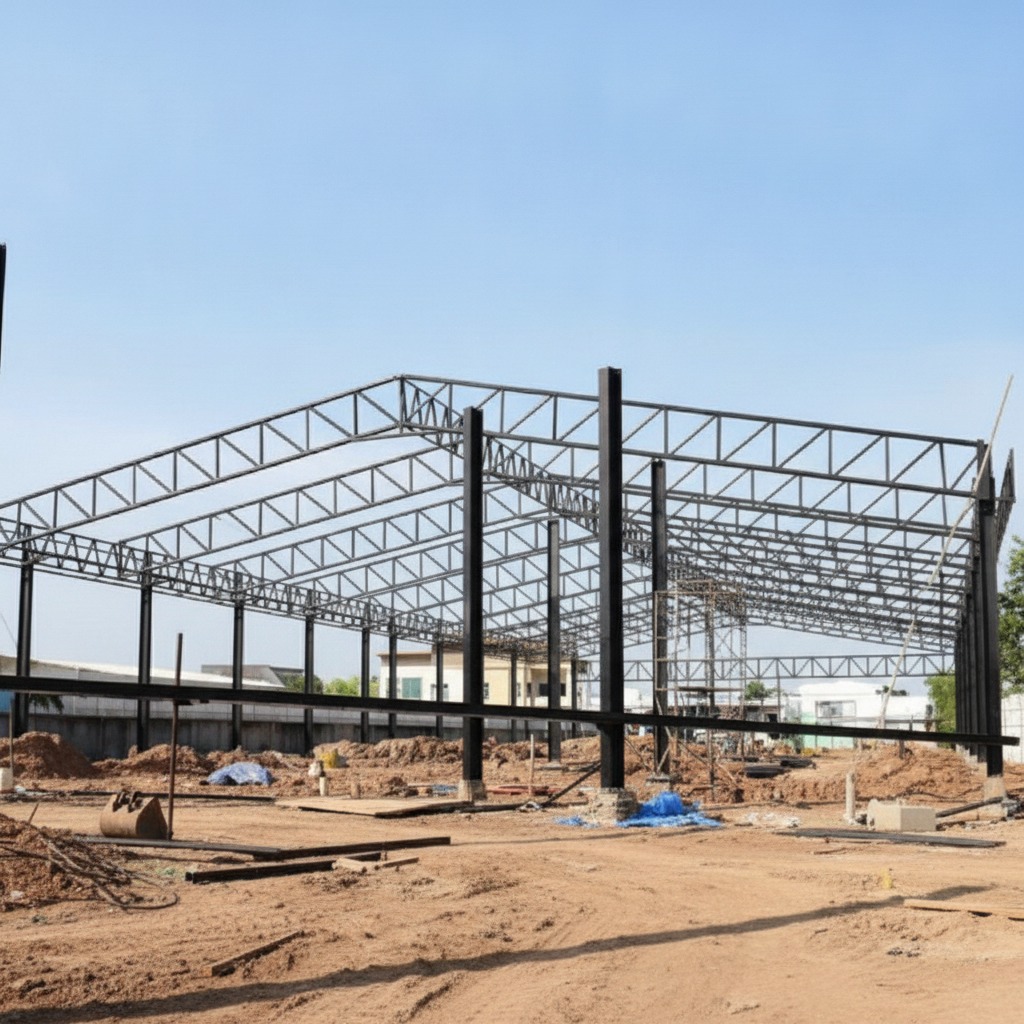
The image shows a large structural steel skeleton at an early stage of construction: tall vertical columns, long-span roof trusses, secondary members, and repeated bays that suggest a serious industrial enclosure rather than a light shed. That matters because buyers often compare buildings only by size on paper, when the real question is how the steel system behaves under load, how much uninterrupted floor area it creates, and what it will cost to fabricate, ship, and erect.
If you are sourcing for a warehouse, logistics facility, agricultural building, or production hall, the frame is not an interchangeable commodity. The right choice changes everything downstream: cladding, crane support, maintenance access, expansion potential, and even how easily the building can be reconfigured later.
Quick takeaways for engineers and buyers
Before you get lost in drawings and quote tables, a few practical truths are worth keeping in mind.
First, a steel building is chosen for span and speed as much as for strength. Long open bays are often the whole point. Second, the structure and its connections should be judged as a system, not a pile of members. Columns, trusses, purlins, bracing, and foundation interfaces all affect performance. Third, coating and corrosion protection deserve early attention. The finish visible on the frame in the image appears industrial, likely a primer or paint system, but the exact specification would need confirmation. That is the kind of detail buyers sometimes leave too late, only to discover it affects both service life and maintenance planning.
How a structural steel frame is put together
The visible frame in the image gives a useful snapshot of how many industrial steel structures are built. You can see dark vertical columns supporting a pitched roof system, with lighter secondary members spanning across the top. That arrangement is common because it balances load-carrying capacity with efficient use of material.
Primary framing
The primary frame carries the heavy loads: roof weight, wind loads, snow where relevant, and any imposed loads from suspended services or equipment. In a large clear-span building, this is usually where the design effort goes. The geometry of the roof trusses or rafters affects deflection, interior clearance, and the way forces move into the foundations.
Secondary members
Purlins and other secondary framing members give the roof cladding something to sit on and help distribute loads back into the main frame. They also influence installation sequence. If the secondary steel is poorly coordinated with the main frame spacing, site crews lose time making adjustments. That sounds minor on paper; on a live construction site, it is not minor at all.
Bracing and stability
Large steel structures need stability as much as strength. Bracing controls lateral movement and helps the frame resist wind and other sideways forces. In open construction stages, before enclosure is complete, this is especially important. A frame can look solid from a distance and still be vulnerable if temporary or permanent bracing is not planned carefully.
Why industrial projects keep choosing steel structures
For many buyers, the appeal starts with the obvious: steel allows large spans and tall clearances with relatively efficient use of material. But the decision often goes deeper.
An industrial steel building can be assembled in a controlled sequence, with members fabricated off-site and erected on-site once foundations are ready. That makes scheduling more predictable than many conventional building methods, though “predictable” is still a relative term. Weather, transport access, lifting equipment, and site readiness all have their say.
Steel structures also make future changes easier. An operation that begins as storage may later need racking, mezzanines, service runs, or production lines. A building with a sensible structural grid is easier to adapt than one designed only to minimize initial steel tonnage.
Key selection criteria when comparing steel structures
When buyers compare steel structures, they should focus on a handful of decisions that have outsized impact.
Clear span versus internal columns: A clear-span layout gives uninterrupted floor space, which is valuable for forklifts, equipment layout, and material flow. Multi-span frames may be more economical in some cases, but columns can interfere with operations if the building is not planned carefully.
Roof form: The roof in the image appears pitched rather than flat. That is typical for industrial steel buildings because pitched roofs can help with drainage and structural behavior. Roof geometry should be selected with climate, drainage strategy, and interior clearance in mind, not just appearance.
Future enclosure: The frame shown is not yet clad. That means the buyer still needs to align roofing sheets, wall panels, doors, and any insulation strategy with the frame layout. A frame that ignores the enclosure package can cause awkward interfaces later.
Surface protection: Coating matters. In industrial environments, the frame may face humidity, temperature swings, dust, or chemical exposure. The right coating depends on the service environment, and it is unwise to assume that any painted surface will behave the same way over time.
Common mistakes in steel building procurement
One of the most common errors is to ask only for overall building dimensions and leave the structural assumptions vague. That usually produces quotes that are hard to compare. Buyers should make sure they understand whether the supplier is pricing a welded frame, a mixed fabrication package, or a prefabricated system. The image alone does not confirm which one is used here, so a careful RFQ should not assume it.
Another mistake is underestimating erection logistics. Large members need access, lifting plans, and sequencing. A beautiful design on the drawing board can become expensive if the site cannot support efficient erection.
There is also a tendency to treat corrosion protection as a finish decision rather than a design decision. That is a poor habit. Once a steel structure is in service, repainting or remediation is disruptive and costly. It is better to specify the exposure conditions early and design the coating system accordingly.
What this kind of frame is best suited for
The structural layout visible here is well suited to buildings that need open, high-volume interiors. Typical applications include warehouses, manufacturing plants, storage sheds, logistics facilities, and agricultural enclosures. These are spaces where columns must be minimized, roof loads must be handled cleanly, and the building may need to stay flexible for future layout changes.
For a buyer, that means the steel structure should be judged less like a fixed shell and more like an operating platform. If the building will carry conveyors, overhead services, gantry equipment, or heavy racking, those needs should be identified at the structural stage rather than patched in later.
Practical advice before you request a quote
Ask suppliers for the structural assumptions behind the design. That includes loading conditions, intended bay spacing, bracing strategy, and the scope of fabrication versus site erection. If you are comparing steel building offers, make sure you know what is actually included. Some quotes cover only the main frame, while others extend to secondary steel or even enclosure components.
It also helps to walk through the building from an operations point of view. Where will forklifts turn? Where do truck doors sit? Will the interior need cranes or suspended lines later? These questions sound obvious, but they often expose structural compromises before they are locked in.
And one practical warning: do not let the phrase “prefabricated” make you assume the job is simple. Large steel structures still require engineering discipline, site coordination, and a clear understanding of tolerances, even if the exact numbers are not published in marketing material.
FAQ: steel structure buying questions that come up early
Is every industrial steel building a prefabricated building?
Not necessarily. Some are prefabricated systems, others are custom-fabricated structural frames, and some are hybrid solutions. The image alone does not prove which one applies.
Why use a steel structure instead of another material?
Steel is commonly chosen for span, speed of erection, and flexibility. It is especially practical when a project needs open interior space and a durable load-bearing frame.
What should I ask about coating?
Ask what exposure environment the building is designed for, what coating system is proposed, and whether any touch-up or maintenance plan is expected after erection. Surface protection is easier to define at procurement than to fix later.
The decision this article should help you make
If you are comparing options for a warehouse, workshop, or factory building, the real decision is not simply “steel or not steel.” It is whether the steel structure you are buying gives you the span, speed, durability, and future flexibility your operation actually needs. A good frame disappears into the background once the building is running. A poor one keeps showing up as delays, awkward layouts, and maintenance headaches.
When you prepare your RFQ, start with the functional brief: required clear space, planned loads, enclosure needs, site conditions, and expansion expectations. Then ask suppliers to respond to that brief with a frame solution, not just a price. That is usually where the difference between a workable industrial building and an expensive compromise becomes visible.