

How to Evaluate a Nursing Pillow for Comfort, Manufacturing Quality, and Safe Use
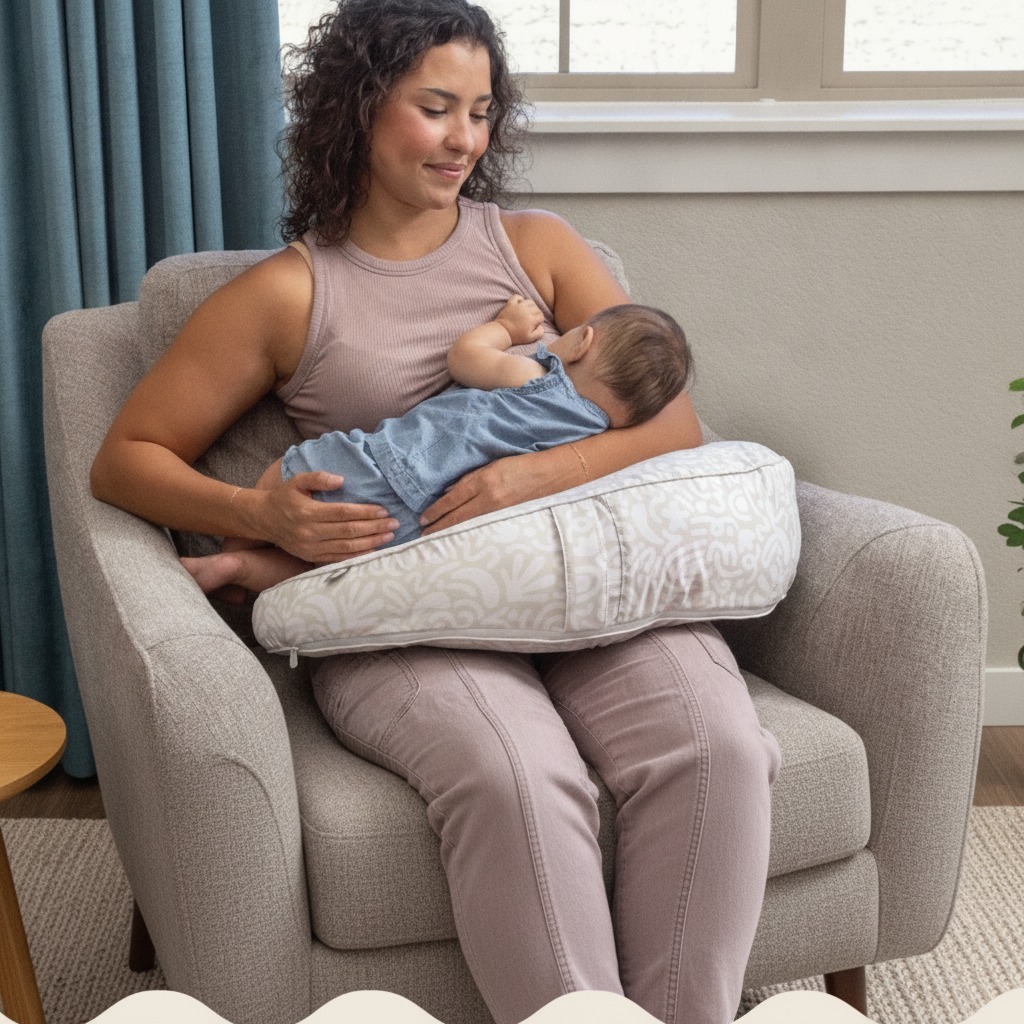
A nursing pillow is a deceptively simple product: a shaped cushion placed across a caregiver’s lap to help position an infant during feeding. For parents, the decision is usually about comfort and ease of use. For retailers, distributors, hospitals, and product teams, the evaluation is broader. They must consider the cushion’s geometry, cover construction, filling, cleanability, packaging, instructions, and the limits of the intended use. This guide explains what to inspect before selecting or sourcing this type of infant-feeding support product.
Why the Product Design Matters
During feeding, a caregiver may hold an infant for extended periods while seated in a chair, on a sofa, or beside a bed. Without support, the caregiver’s arms and shoulders carry much of the load. A well-shaped cushion can bring the infant closer to a more comfortable height and provide a broader resting area across the lap. It may also support the caregiver’s forearms, elbows, or torso, depending on the design.
That benefit depends on more than softness. A cushion that compresses too easily may allow the infant to sink or shift. A cushion that is too firm, too narrow, or poorly shaped may create pressure points and fail to remain stable. The product should therefore be judged as a combination of shape, surface, filling, cover, and instructions—not simply by its appearance in a product photograph.
Quick Reference: What Buyers Should Check
- Shape: Look for a broad, elongated profile that sits securely across the lap or around the waist without creating an awkward gap.
- Support surface: A raised cushion body with a relatively flat upper surface can provide a predictable area for positioning, but actual performance must be confirmed through inspection or testing.
- Cover construction: Check seams, piping, zipper installation, fabric feel, and access for cleaning.
- Filling: Request the exact material, density or firmness information where relevant, and details about recovery after compression. These characteristics cannot be confirmed from appearance alone.
- Care information: Do not assume that a zipper means the cover is machine-washable. Written laundering instructions are still required.
- Use boundaries: Confirm the intended infant age range, supervised-use instructions, and any warnings about sleep or unattended use.
- Supply documentation: Ask for dimensions, materials, labeling, packaging details, and applicable market requirements before placing a production order.
Reading the Product Geometry
The visible product category is a broad, curved support cushion designed to sit across the caregiver’s lap. Its wraparound or crescent-like profile can help create a continuous contact zone rather than a narrow pad beneath the infant. In practical use, the upper surface should be wide enough to accommodate normal positioning without forcing the caregiver to hold the infant at an unusual angle.
Geometry also affects storage and shipping. A thick, rounded cushion may be comfortable but consume more carton volume than a flatter design. Compression packaging may reduce freight volume, yet it introduces questions about recovery time, permanent deformation, odor, and whether the cover wrinkles or loses its intended fit. These issues should be reviewed with the manufacturer rather than inferred from a sample that has only been handled briefly.
Buyers should request a dimensional drawing showing overall length, width, height, inner curve, and any changes in thickness. A photograph can show the general form, but it cannot reliably show whether the product will fit a range of caregiver body sizes or remain stable on different seating surfaces.
Cover, Seams, and Serviceability
The visible cover appears to be a light-colored woven or knit textile with a white-on-beige abstract pattern. Perimeter piping or seam binding gives the edge a defined outline, while a zipper along the lower or side edge suggests that the cover may be removable. These are useful construction features, but they are not proof of washability, durability, or hygienic performance.
For a product used around infants, the cover deserves close attention. Inspect whether the zipper pull can be covered or positioned away from regular contact. Look for smooth seam transitions, secure thread ends, consistent piping, and an opening large enough to remove the cover without excessive stretching. A narrow opening can make cleaning difficult and may encourage users to avoid removing the cover altogether.
Pattern alignment is another practical quality signal, especially when the product is sold as a premium textile item. Misaligned motifs may not affect function, but they can increase returns in retail channels. More important are puckered seams, uneven fullness, exposed stitching, or a cover that shifts over the filling. A small inspection sample should be opened where possible, because external appearance cannot reveal whether the internal cushion is evenly formed.
Filling Material: Ask Before You Assume
The internal filling is concealed in the available product view. It could be fiberfill, foam, or another cushion material, but that cannot be confirmed visually. The distinction matters. Fiber-based filling may create a softer, more flexible cushion, while foam can offer a more defined shape. Different constructions also behave differently after repeated compression, laundering, storage, and transport.
When sourcing, request the filling specification and a description of how the shaped core is produced. The manufacturing route may involve cutting or forming an internal insert, sewing a liner, inserting loose fill, or assembling multiple layers. Each method creates different inspection points. Loose filling must be distributed consistently; shaped foam should fit the cover without excessive gaps; layered constructions should not separate or migrate during normal handling.
Do not accept vague terms such as “premium filling” as a substitute for technical information. The buyer may not need a highly complex specification, but should know enough to compare samples and control production consistency. Compression recovery, firmness, odor, and dimensional stability are sensible topics for a supplier discussion, even when no particular performance value has yet been defined.
Manufacturing Process and Quality Control
A typical sewn cushion of this type may involve patterned-fabric cutting, panel assembly, piping installation, zipper sewing, edge closing, and insertion of the shaped filling. Production quality often depends on the sequence. If the cover is cut inaccurately, the finished cushion may twist or develop uneven fullness. If piping is sewn under inconsistent tension, the edge can wave. If the zipper is installed too close to a seam allowance, it may snag or distort the opening.
A practical quality-control plan should include incoming fabric inspection, pattern and cut-part checks, seam inspection, zipper operation, cover-to-core fit, and final visual review. Sampling should include cushions from different production times, not only the first approved sample. This is particularly important when fabric lots, filling suppliers, or subcontracted sewing operations may change.
For private-label products, buyers should also approve the artwork, label placement, packaging, and care instructions as controlled components. A visually attractive beige pattern and contrasting piping can help establish a retail identity, but they should not distract from basic questions about use, cleaning, and supervision.
How to Select the Right Product for the Market
Start with the intended channel. A product for direct-to-consumer retail may need strong visual presentation, clear photography, and compact packaging. A maternity facility or postpartum-care provider may place more emphasis on cleaning procedures, replacement covers, durability, and straightforward instructions. A distributor may need several colorways or private-label options while still requiring consistent dimensions across the range.
Next, define what the product is—and what it is not. It may be suitable as a feeding support cushion or general infant-holding aid when used as directed. That does not mean it is suitable for infant sleep, unattended positioning, or use as a restraint. The product listing, sewn-in label, packaging, and instruction sheet should communicate those boundaries clearly. If the intended age range or warning language has not been established, resolve that before commercialization rather than leaving the issue to informal customer interpretation.
Finally, compare physical samples under realistic conditions. Place the cushion on several seating surfaces, examine whether the cover shifts, and inspect the underside and zipper area. Have more than one person assess the fit, because a shape that works well for one caregiver may feel too high or too narrow for another. These simple checks often reveal more than a polished catalog image.
Common Buying Mistakes
- Assuming removable means washable: Confirm the care method, water temperature guidance, drying instructions, and whether the filling must remain dry.
- Choosing by softness alone: Excessive softness may reduce positioning stability or cause the cushion to lose its shape.
- Ignoring cover-to-core fit: A loose cover can wrinkle and shift; an overly tight cover can stress seams and the zipper.
- Using appearance as a safety claim: Attractive fabric, piping, and a tidy silhouette do not establish compliance, durability, or suitability for unsupervised use.
- Failing to review compressed samples: If the product will be compressed for shipment, inspect recovery after unpacking and storage.
- Leaving documentation until launch: Dimensions, material content, warnings, care information, and market-specific requirements should be settled during development.
Questions to Ask a Supplier
Before approving a purchase, ask for the complete product specification, including finished dimensions, cover fiber content, filling type, construction method, zipper details, available colors or patterns, packaging format, and care instructions. Request confirmation of the intended use and any limitations. If the supplier refers to testing or certification, ask for the applicable document and scope rather than relying on a general statement.
Also clarify whether the visible design can be customized. Pattern changes, piping colors, labels, replacement covers, and carton artwork may affect minimum order quantities and production controls. Exact pricing and lead times should be quoted for the defined specification; they should not be assumed from a sample or image.
FAQ
Is this type of pillow suitable for infant sleep?
It should not be treated as a sleep product unless the manufacturer has specifically designed, evaluated, and labeled it for that purpose. A feeding support cushion is generally intended for supervised use during feeding or holding, following the supplied instructions.
Does a zipper guarantee easy cleaning?
No. A zipper indicates potential cover removal, but cleaning depends on the cover material, construction, and care instructions. Confirm those details in writing.
What filling is best?
There is no universal answer. Fiberfill, foam, and other cushion materials can produce different levels of firmness, flexibility, recovery, and washability. Select the filling based on the intended geometry, care method, packaging plan, and tested sample performance.
What should be approved before mass production?
Approve the physical dimensions, shape, cover fabric, pattern, piping, zipper, filling, labels, warnings, care instructions, packaging, and inspection criteria. A signed sample alone may not control every production detail.
Next Step for Product and Sourcing Teams
Turn the product image into a controlled specification before requesting volume pricing. Define the support geometry, cover construction, filling information, cleaning expectations, intended use, warnings, packaging, and inspection points. Then compare supplier samples against that document under realistic handling conditions. This approach helps buyers select a nursing pillow that is not only visually appealing, but also manufacturable, serviceable, and appropriately presented to the end user.