

How to Evaluate a Nursing Pillow for Private-Label and Retail Programs
A nursing pillow is a deceptively simple soft-goods product: a curved cushion placed across a caregiver’s lap to support an infant during feeding. For product teams and sourcing managers, however, the buying decision involves more than selecting an attractive print. Shape, cover construction, filling, cleanability, packaging, intended-use language, and production control all influence whether the finished item is practical for families and commercially suitable for a baby-care range.
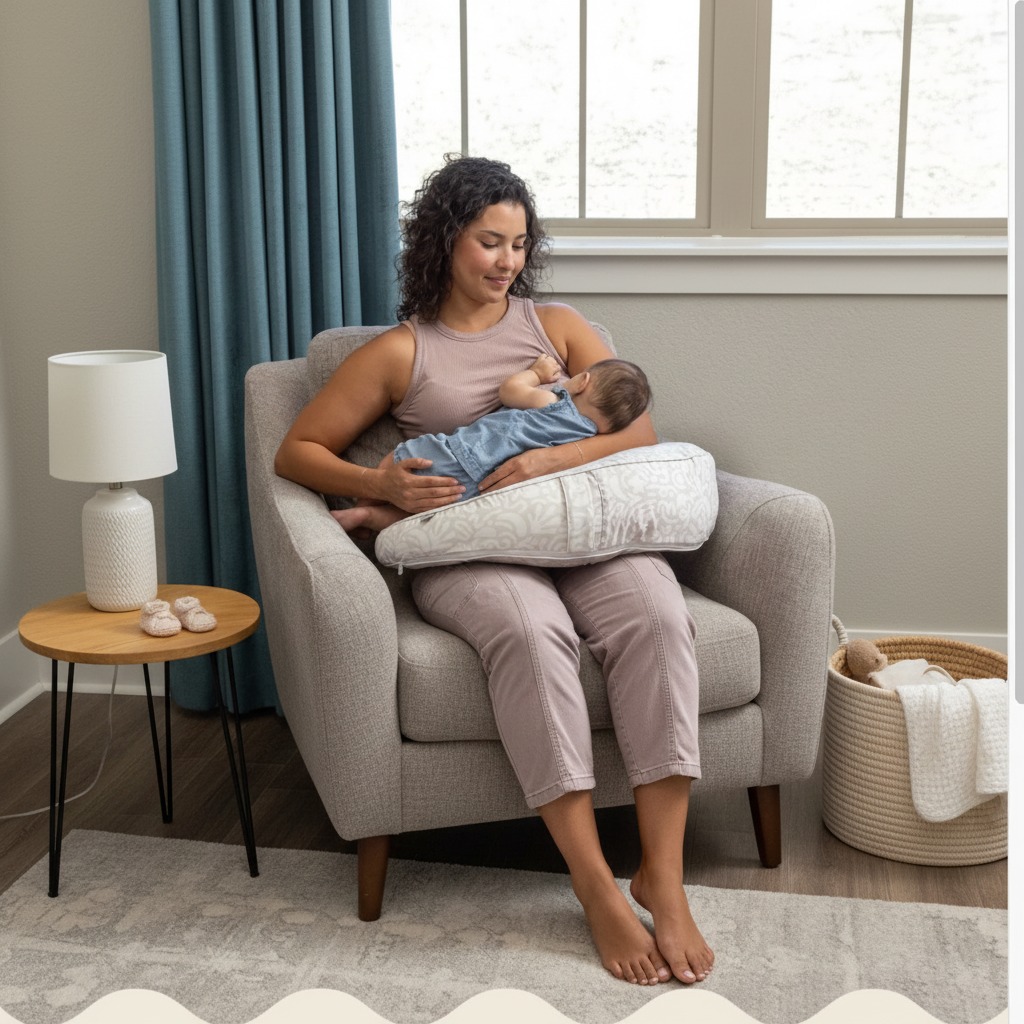
The product shown has the familiar elongated, curved form associated with a breastfeeding pillow. It includes a broad central support area, raised rounded sides, a patterned textile cover, perimeter stitching, and what appears to be a concealed or covered zipper along the lower edge. Those visible features provide a useful starting point, but they do not confirm the internal filling, fabric composition, wash performance, safety testing, or exact dimensions. A buyer should treat the image as a design reference, not as a complete technical specification.
What the Product Decision Really Involves
Retailers and private-label brands are usually deciding between several priorities at once. The pillow must look appropriate in a nursery setting, feel stable enough for its intended feeding application, remain manageable during cleaning, and arrive in packaging that protects its shape without creating excessive freight volume. At the same time, claims about infant use must be carefully controlled.
A well-designed feeding pillow can support a caregiver’s arms and help position an infant during breastfeeding or bottle-feeding. It should not automatically be presented as a sleep product, a medical device, a posture-correction product, or a substitute for supervision. Those distinctions matter on packaging, product pages, instruction sheets, and marketplace listings.
Quick Reference: Visible Features and Open Questions
| Area | What is visible or reasonably indicated | What the buyer must confirm |
|---|---|---|
| Overall form | Large curved or U-shaped cushion with raised side sections | Finished dimensions, shape tolerance, and fit across common seating positions |
| Cover | Light beige textile with a white abstract pattern | Fiber content, fabric weight, colorfastness, abrasion performance, and restricted-substance requirements |
| Closure | Covered zipper appears to run along the lower edge | Zipper quality, puller safety, seam strength, replaceability, and closure access |
| Interior | Padded appearance; filling is not visible | Fiberfill, foam, or other filling type; firmness; recovery; odor; and compression behavior |
| Care | Removable cover is suggested by the zipper | Whether the cover is machine washable, drying instructions, shrinkage, and replacement-cover availability |
| Use claims | Suitable in concept for seated feeding support | Approved intended-use language and all applicable market requirements |
Construction Details That Deserve Close Review
Shape and pattern engineering
The curved profile is more than a visual choice. The central section must provide enough contact area for the caregiver’s arms and the infant’s supported position, while the side sections wrap toward the torso without creating an awkward gap or excessive pressure. A pattern that looks balanced on a flat sample may behave differently when placed on a lap or a soft sofa.
Ask the manufacturer for a dimensioned drawing rather than relying on a product photograph. The drawing should identify overall length, maximum width, height, side-section geometry, and any relevant seam allowances. It is also worth checking whether the finished shape is measured before or after filling, since compression and loft can change the result.
Cover and closure
The textile cover gives the product much of its retail character. The pictured neutral background and abstract white pattern would fit a restrained nursery assortment, but the decoration process is not identifiable from the image. It may be printed or woven, and the distinction should be confirmed before costing and sampling.
The zipper is a practical feature because it may allow the cover to be removed for laundering or replaced after wear. It is not enough to specify “hidden zipper.” Buyers should review the zipper position, tape quality, puller design, end finishing, and whether the closure can be opened without stressing the surrounding seam. A zipper that is technically concealed but difficult to operate is a small annoyance that becomes a customer-service issue over time.
Filling and support behavior
Nothing in the supplied product view establishes whether the interior uses polyester fiberfill, foam, shredded material, or another cushioning construction. That choice affects firmness, weight, loft, recovery after compression, shipping volume, and the way the pillow feels during feeding. It also affects whether the inner cushion can be cleaned separately from the cover.
For development samples, evaluate the pillow in both a seated feeding position and after repeated compression. Check whether the center collapses, whether the side sections remain symmetrical, and whether the cover develops loose areas or wrinkles. These are practical observations, not a substitute for formal testing, but they often reveal pattern or filling problems early.
Manufacturing Process: Where Quality Is Won or Lost
This product fits the cut-and-sew soft-goods category. A typical production route may include fabric inspection, marker planning, cutting, printing or material preparation where applicable, panel sewing, zipper installation, cover turning, filling, final closure, inspection, and packing. The exact process will vary with the selected material and interior construction.
For a curved pillow, panel matching and seam consistency deserve particular attention. Small differences in cut panels can produce a visibly uneven U-shape. Stitch density, seam allowance, and corner or curve handling should be reviewed on the prototype. The perimeter seam should look smooth rather than puckered, especially around the transition between the central area and raised sides.
Pattern placement is another buyer-facing concern. If the fabric uses a repeating abstract design, request a clear standard for orientation and visible panel matching. A low-cost fabric can become expensive if a production lot has inconsistent print direction or noticeable shade variation.
How to Select a Supplier
Start with a technical brief that separates confirmed requirements from open decisions. Include the intended feeding application, target markets, approximate size range, cover construction, preferred closure, decoration method, packaging format, labeling needs, and acceptable visual standards. Do not leave “soft” or “supportive” as the only performance descriptions; those words are interpreted differently by different factories.
Request a pre-production sample made with the proposed fabric, zipper, filling, and sewing method. A showroom sample made from substitute materials may be useful for reviewing shape, but it cannot answer questions about final hand feel, color, shrinkage, or filling recovery.
Supplier questions should include:
- Which filling constructions can be offered, and how is consistency controlled between batches?
- Can the cover and inner cushion be separated for care or replacement?
- What fabric and zipper options are available for the target market?
- How are dimensions, seam appearance, print placement, and fill level inspected?
- What packaging method is used, and does compression affect final shape?
- Which product documents, labels, warnings, and market-specific compliance records can be provided?
These questions are more useful than asking only for the lowest unit price. A small difference in filling consistency or cover workmanship can change the customer’s experience, while a missing document or unclear care instruction can delay a launch.
Common Buying Mistakes
The first mistake is assuming that a removable cover automatically means machine washable. The zipper suggests removability, but wash instructions, shrinkage, colorfastness, and dimensional stability still require confirmation and testing.
The second is treating the visible design as proof of performance. A broad padded surface may look comfortable, but the image does not establish firmness, ergonomic benefit, infant positioning performance, or load limits. Those claims should be supported before they appear in marketing copy.
The third is using broad infant-use language without defining supervision. A nursing pillow intended for seated feeding should not be marketed casually for infant sleep, unsupervised lounging, or other applications unless the product has been specifically designed, assessed, and labeled for them. Follow the requirements of the destination market and obtain qualified regulatory guidance when needed.
Finally, do not approve a sample only from photographs. Photographing a pillow can hide an uneven seam, a shallow fill area, or an inconvenient zipper. Physical review is particularly important for a product that sits against the body and is used around an infant.
FAQ for Buyers
Is this product only for breastfeeding?
Not necessarily. The form may also support bottle-feeding and seated caregiving, but the final product description should reflect the manufacturer’s intended-use instructions and the evidence available for the product.
Can the cover be washed?
The zipper suggests that the cover may be removable. It does not confirm machine-washability or any particular wash rating. Obtain written care instructions and verify them through suitable testing before publishing a claim.
What filling should a buyer choose?
There is no single correct answer without a defined target for firmness, weight, recovery, cleaning, and cost. Compare filling options through physical samples and compression checks, then document the approved construction in the purchase specification.
Is the pillow suitable for infant sleep?
The supplied information does not establish that use. A feeding-support cushion should not be presented as an infant sleep product without specific design validation, safety review, and appropriate instructions.
Next Step: Turn the Image Into a Controlled Product Brief
The pictured nursing pillow offers a clear starting concept: a broad curved cushion, raised side sections, a patterned textile cover, stitched perimeter seams, and a likely removable-cover construction. The next decision is not simply whether the design looks appealing. It is whether a supplier can reproduce the shape, hand feel, closure, cover appearance, and intended-use presentation consistently at production scale.
Before requesting a quotation, prepare a dimensioned sketch, list the unknown materials as open choices, define the intended application, and ask for a sample using proposed production components. Review construction, care, labeling, packaging, and market requirements together. That process gives product teams a firmer basis for comparing manufacturers and reduces the risk of approving a visually attractive pillow that is difficult to clean, inconsistent in shape, or marketed beyond what its specifications support.