
Why a plain red sock still matters in B2B buying
A sock may look like a small item, but in uniforms, retail basics, school programs, and promotional bundles it often carries more weight than buyers expect. A single-color red pair does one job very clearly: it gives the wearer a consistent, easy-to-recognize base layer without the distraction of patterning, logos, or contrast trim. That simplicity is not a weakness. For the right program, it is the point.
For sourcing managers and product teams, the decision is rarely just about color. It is about fit consistency, visual uniformity, and whether the item can be repeated across dozens or thousands of pairs without drifting in shade or shape. A solid red pair can work for casual apparel, school outfits, team kits, workwear with a single-color requirement, or basic retail assortments where the buyer wants a clean, no-frills garment. It can also be a practical choice when the brief is more about identity than technical performance.
Quick takeaways before you place an order
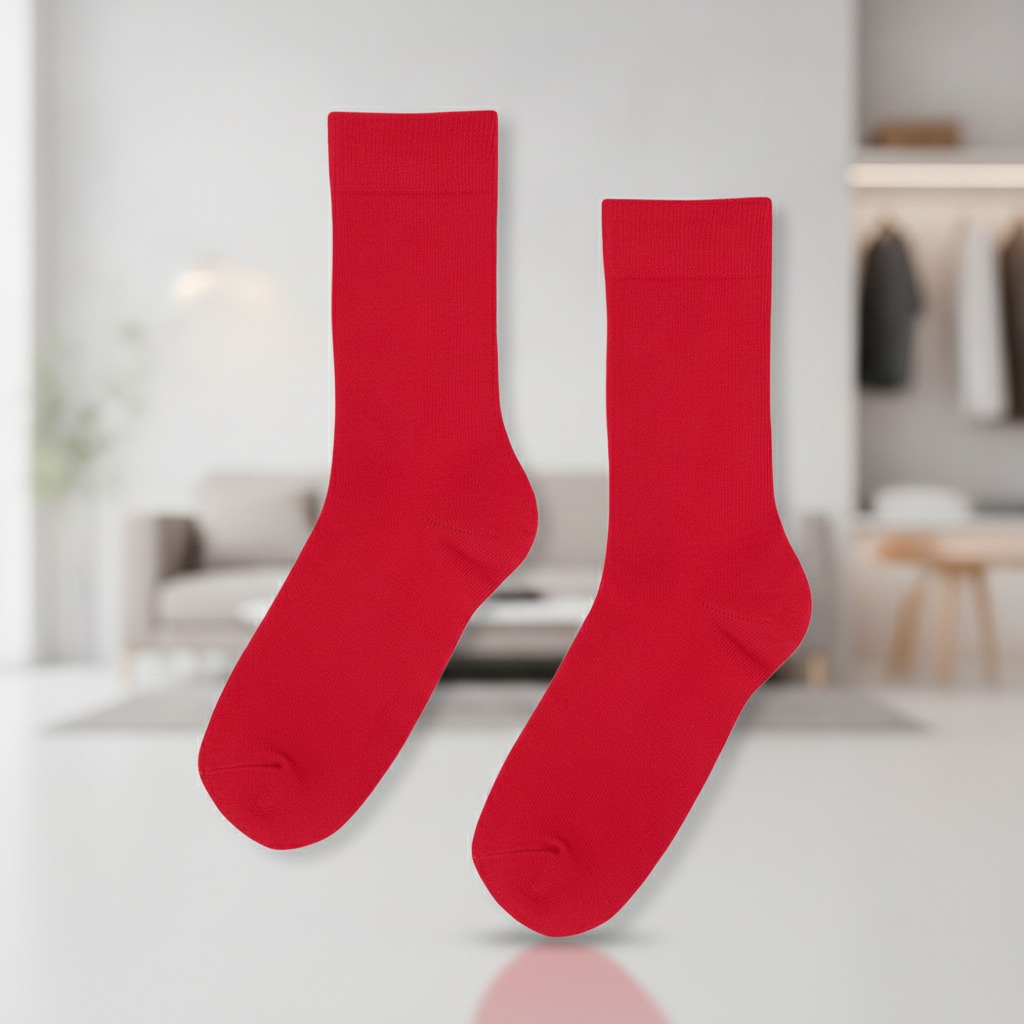
The product described here is a matched pair of knit socks with a matte finish, a straight-looking shaft, and a simple rounded toe and shaped heel. The visual profile suggests a crew-length or mid-calf style, though exact height should be confirmed at sample stage. There is no visible pattern, logo, or contrast trim, which makes the item easy to position as a uniform basic or promotional blank.
If you are evaluating this kind of product for procurement, the main questions are straightforward: does the color hold consistently from pair to pair, does the size range fit the intended end user, and does the construction feel appropriate for the end use? Those details matter more than a flashy specification sheet, especially when the sock is part of a larger apparel program.
What the product is, and what it is not
This is a pair of solid red textile socks. The knit surface appears plain and matte, with no visible texture pattern and no branding. The shape shows a conventional lower-leg and foot structure, which is typical of mass-produced hosiery. In practical terms, that means the product fits comfortably into everyday wear and basic institutional programs.
What should not be assumed is just as important. Fiber content is not visible, and neither are thickness, cushioning, compression, moisture management, or reinforcement details. Those qualities can vary widely across products that look similar in a photo. A buyer who assumes a simple appearance equals a simple specification often ends up with surprises later, usually in fit complaints or color inconsistency. That is a costly way to learn that two visually similar socks are not interchangeable.
How this kind of sock is typically made
From a manufacturing point of view, this looks like standard knitted hosiery with finishing at the toe and cuff area. The exact construction cannot be confirmed from appearance alone, but the product likely belongs to the family of everyday knit socks made on hosiery equipment, then closed, shaped, and paired for sale. That production route is common for uniform basics because it supports repeatability and relatively efficient output.
Why the simple structure can be an advantage
A minimal design leaves fewer places for defects to hide and fewer features to mismatch across a batch. There is no stripe alignment to worry about, no logo placement, and no decorative trim to source. For procurement teams, that often translates into easier communication with suppliers and fewer approval rounds. It also makes the item more flexible across markets, because a plain red sock can serve as a school item in one channel and a retail basic in another.
Where buyers should stay cautious
Minimal design does not mean minimal risk. A solid dye color can reveal shade variation immediately when cartons are opened side by side. Simple knit surfaces can also show uneven tension, twisted shape, or inconsistent toe closing more readily than a busier product. The absence of decoration places more pressure on material quality and manufacturing control. In other words, plain products tend to expose small problems rather than hide them.
Selection criteria that matter more than the picture
For sourcing teams, the first step is to lock down intended use. A sock for men in a workwear program may need a broader size range and a different leg feel than a sock for women sold as retail basics or used in a school pack. Even when the product is unisex, the distribution of foot sizes and shaft fit should match the customer profile. That sounds obvious, but it is where many basic apparel programs go wrong.
Next, ask the supplier to confirm the exact sock height, size range, and packaging format. The visible silhouette suggests a crew or mid-calf profile, but buyers should not rely on assumption when the end application depends on how much leg coverage is needed. A pair that works under trousers in one market may feel too short in another. Small differences in height can change the whole buying decision.
Color consistency is another major checkpoint. Red is a high-visibility shade, which can look excellent in a display box and unforgiving in a production batch if dye lots drift. Ask how the color is controlled across repeat orders, how the supplier manages batch matching, and whether pre-production samples represent the intended run. This is especially important for school or team programs where a mismatch looks sloppy immediately.
Then there is hand feel. The article cannot tell you whether the fiber is cotton, polyester, wool, or a blend, and nobody should pretend otherwise. But the end-user experience will depend heavily on what is used. A buyer who wants everyday comfort may prioritize softness; a buyer who wants uniform durability may prioritize shape retention and easy care. Those are different targets, and the wrong assumption can make an otherwise decent product feel wrong on foot.
Common mistakes in sourcing plain socks
The biggest mistake is treating all basic socks as interchangeable. They are not. Two red pairs can look nearly identical on a screen and behave differently in wear, wash, and storage. Another common error is approving a photo without confirming the actual red shade under daylight or standardized lighting. Display screens are poor judges of textile color, and no procurement team wants a program delayed because the red was closer to brick than expected.
A second mistake is ignoring the end user. A sock for men in a workwear bundle may need a sturdier construction profile than a sock for women in a retail set, even if the graphics brief is the same. If the item is meant for repeated laundering, ask how the fabric behaves after washing cycles and whether the toe seam feels acceptable. Buyers often spend too much time on carton appearance and too little on the part that touches the foot all day.
One more caution: do not over-specify features that the product does not visibly claim. If cushioning, compression, or moisture-wicking are important, they should be explicitly requested and verified. A plain matte sock can be many things, but it is not safe to assume technical performance from appearance alone.
Practical buyer advice for uniform, retail, and promotional programs
If you are buying for a uniform program, request a sample in the target size range and test it with actual wearers, not just internal reviewers. A sock that looks balanced on a sample card may fit differently on a broader user base. For promotional merchandise, focus on color consistency and package presentation; the product may be simple, but it still has to look intentional when it reaches the recipient.
For retail basics, the story is a little different. Consumers notice comfort first, then shape, then price. A plain red pair with no decoration can work well as a seasonal basic or value line item, but only if the fit feels dependable and the finish looks clean. The straight shaft and rounded toe should read as deliberate simplicity, not a rushed blank.
For school or team use, make sure the red shade is approved against the broader program palette. “Red” sounds simple until the actual cartons arrive and the shirts, shorts, and socks do not agree with one another. It is a small mismatch that becomes visible in a line of twenty students or a full team photo.
FAQ for sourcing teams
Is this sock intended for men or women?
The product can be positioned for either market depending on size range, packaging, and buyer brief. For a sock for men or a sock for women, the practical difference is usually fit expectation rather than visual appearance alone.
Can the construction be confirmed from the image?
Only partly. The product appears to be a knit sock with standard finishing, but the exact fiber content, toe closure method, and performance features should be confirmed with the supplier before approval.
Is a plain red design good for branded programs?
Yes, especially when the program wants a consistent base item without competing graphics. A solid color can be easier to integrate into uniforms and promo sets, provided the shade is controlled tightly.
What should be checked before mass production?
Confirm size, color shade, packaging, material, and the wearer profile. If the product will be used in a demanding environment, ask for any available performance information rather than assuming the simplest version will be enough.
What to ask a supplier next
Before you place a bulk order, ask for a physical sample, a clear size spec, the exact fiber composition, and a confirmation of the red shade under agreed lighting conditions. If the program involves repeat replenishment, ask how the supplier handles batch consistency. Those questions are basic, but they prevent expensive misunderstandings later.
A plain pair of socks is easy to underestimate. It is also one of the easiest apparel items to get slightly wrong. When the item is meant for daily wear, that small error gets repeated with every step. If you are building a uniform, retail, or promotional program, start with the simple things: fit, color, finish, and repeatability. Then ask the supplier to prove them.