
PCBA: What the Difference Really Means When You Are Buying Boards, Not Just Looking at Them
In sourcing conversations, pcba is one of those terms that gets used casually until a project is suddenly late, a quote is incomplete, or an engineering team realizes the “board” in the drawing is not the same thing as the “board” arriving on the dock. A PCB and a PCBA may look closely related in a photo, but in manufacturing terms they sit on different sides of the production line. One is the bare platform; the other is the board after component placement and soldering, ready to function inside a device.
That difference matters because it changes almost everything a buyer needs to evaluate: process scope, quality checks, supplier capability, cost structure, rework risk, and the handoff between design and production. If you are a sourcing manager, an engineer, or a product team member trying to choose between a bare PCB order and a full assembly service, the question is not just “what is it?” It is “what do I actually need delivered, and who is responsible for making the board work?”
PCB vs. PCBA: the practical distinction
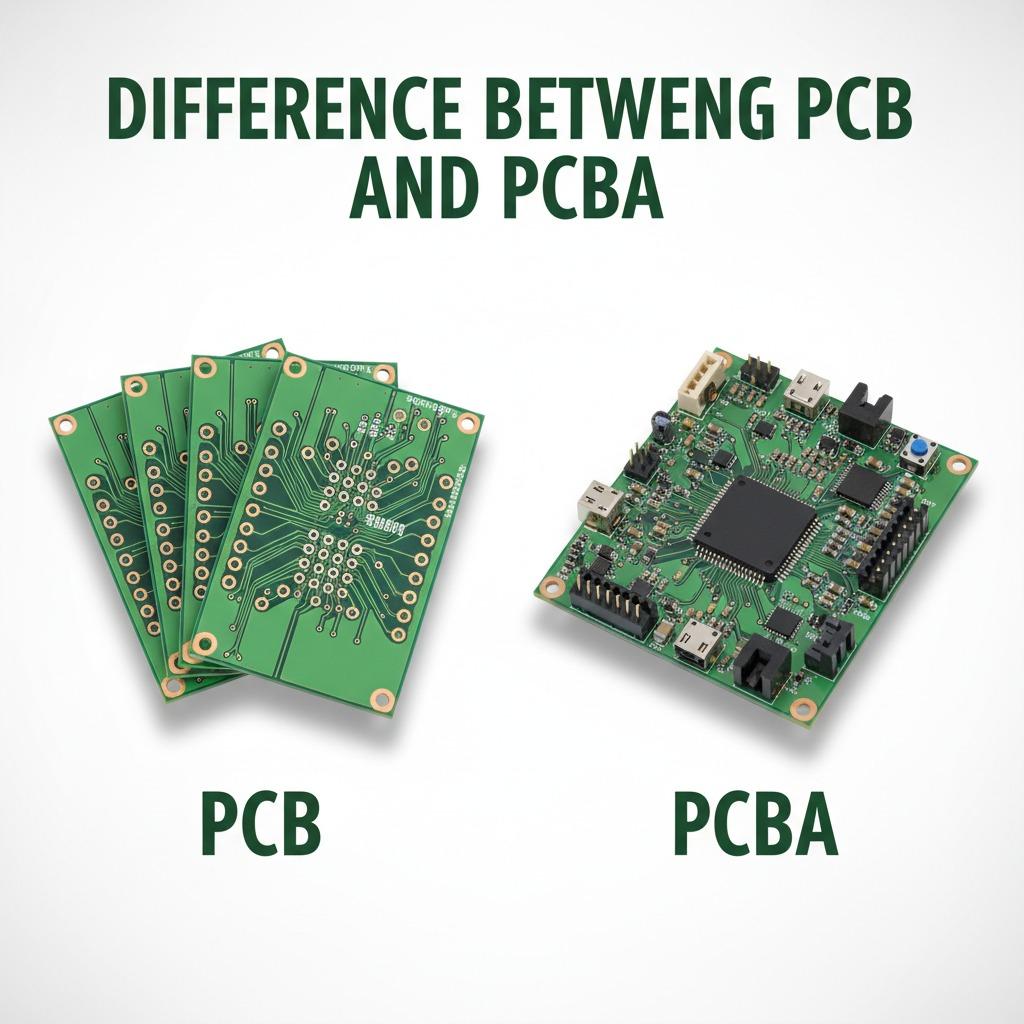
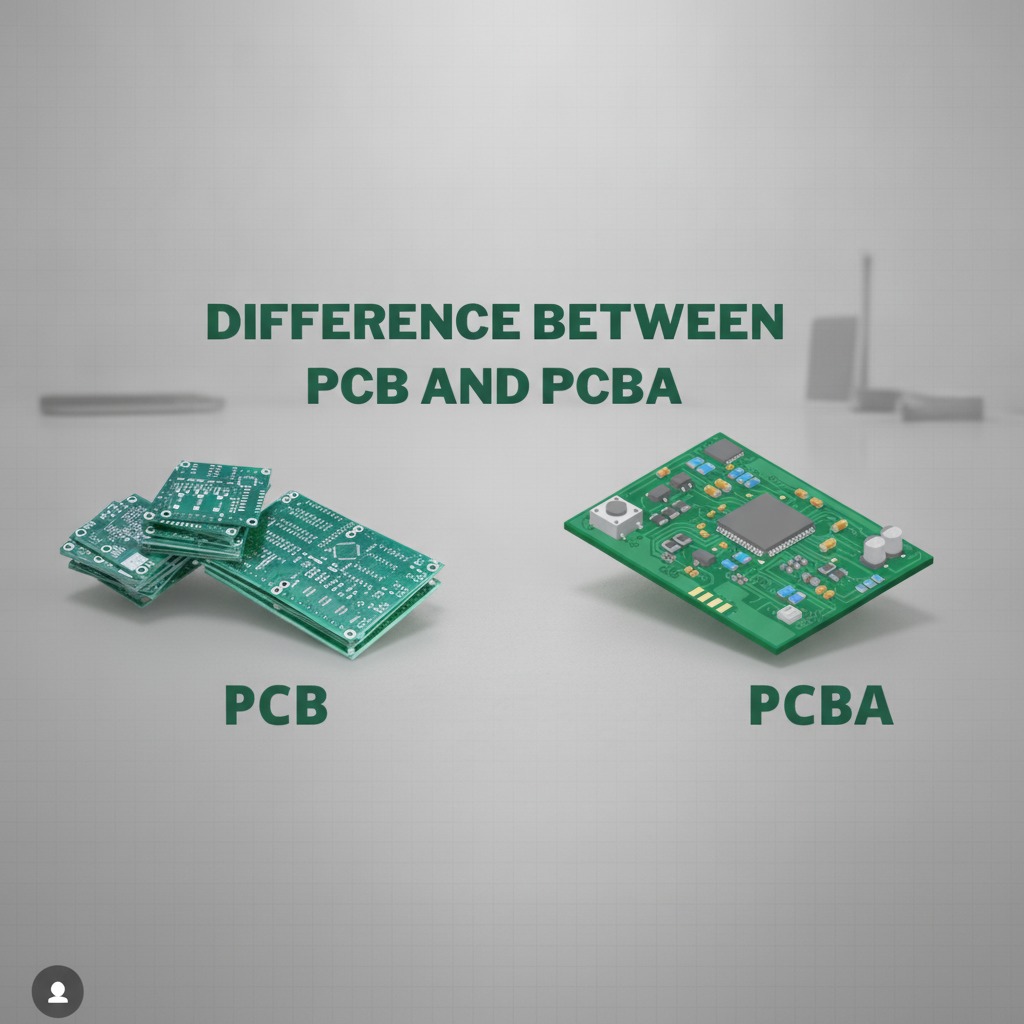
A PCB, or printed circuit board, is the substrate. It provides the mechanical support and the copper pathways that allow signals and power to travel between points on the board. In the comparison image, that is the unpopulated board on the left: green solder mask, exposed copper traces, vias, and mounting holes, but no mounted parts.
A PCBA, or printed circuit board assembly, is the next step. The same kind of board has been populated with electronic components and soldered into place. In the image, that means the right-hand board with an integrated circuit in the middle, smaller passive components around it, and a few larger connectors or switch-like parts. In ordinary buying language, a PCB is the shell; a PCBA is the working assembly, or at least the assembly stage that gets you much closer to a working module.
That sounds obvious until a quotation request crosses desks. A team may ask for a board price and get quoted only for fabrication, while the actual project requires sourcing components, placement, soldering, and inspection. The result is a schedule slip that looks small on paper and expensive in real life.
Quick reference: what changes when you move from PCB to PCBA
For buyers, the simplest way to think about the shift is this:
A PCB order mainly concerns fabrication: stackup, materials, copper patterning, drilling, solder mask, and final finish. A PCBA order adds assembly: component sourcing or consignment handling, pick-and-place, soldering, cleaning if required, inspection, and often test.
That extra scope is not just more labor. It introduces more failure points and more decisions. Component availability can affect schedule. Package style can influence assembly yield. Connector orientation, polarity marking, and thermal balance can all matter more than they do on a bare-board drawing. A board that is perfectly manufacturable as a PCB may still be awkward to assemble efficiently, especially if the layout mixes tiny passives with heavier connectors or uses parts that are difficult to source consistently.
Why pcba is usually a procurement decision, not just a technical term
Many teams treat assembly as a downstream detail, but the experienced ones know it affects the whole product path. If you are building consumer electronics, industrial controls, or embedded systems, the PCB itself rarely leaves the factory alone. It becomes useful only after it is populated. That means the real buying decision is often not “Can this board be made?” but “Can this board be made, assembled, verified, and repeated without drama?”
There is a subtle but important distinction here. A bare PCB supplier may be excellent at laminates, drilling, and trace accuracy. A PCBA supplier must also handle component flow, assembly discipline, soldering quality, and some form of inspection or test coordination. Those are related skills, but not identical. A buyer who assumes one capability automatically includes the other can end up with a vendor that is strong on fabrication and weak on assembly logistics, or the reverse.
How PCBA manufacturing usually unfolds
Although every factory arranges the sequence a little differently, PCBA制造 generally follows a familiar arc. The bare boards arrive first. Components are prepared next, whether by the assembler or by the customer. Placement equipment sets the small parts, and soldering bonds them to the board. Depending on the design, some through-hole parts may be inserted later, and a mixed assembly may combine surface-mount and through-hole operations.
After that comes the part many buyers underestimate: inspection. Visual checks, electrical checks, and functional checks all serve different purposes. One catches soldering defects, another helps identify opens and shorts, and a functional test is where the assembled board proves whether it behaves as intended in a real circuit environment. The exact test method is not visible in the provided image, so it would be a mistake to assume one. Still, a serious buyer should ask how the assembler verifies quality, because a neat-looking board is not always a trustworthy one.
What can be seen in the image, and what cannot
The comparison graphic shows a very clear visual contrast: the PCB side is bare, while the PCBA side is populated. That is useful because it removes ambiguity about terminology. What it does not show is equally important. It does not confirm board material grade, layer count, copper thickness, surface finish, electrical performance, or final end use. It also does not tell us whether the assembly used SMT only, mixed technology, or any special process steps. Buyers should resist the temptation to infer too much from a clean product image.
Selection criteria for buying PCBA services
If you are sourcing a pcba supplier, the first filter is usually not price. It is fit for the assembly task. Can the supplier work with the package types on your bill of materials? Can they handle the board size and component density? Do they have a stable process for placement and soldering? Can they support the kind of inspection your product needs?
Then comes material and supply-chain control. Some buyers want the assembler to source parts; others provide all components themselves. Either route can work, but each has its own risk profile. Supplier-sourced components can save coordination effort, yet they require confidence in procurement discipline and part traceability. Customer-supplied parts can tighten control, yet they shift more responsibility onto the buyer. There is no universal best option, only the least painful one for your program.
One practical caution: do not bury critical parts in a BOM without checking lead time or alternates. A board layout can be fully ready while a single connector or IC stalls the entire assembly run. That is a common source of avoidable delay, and it tends to show up right when teams think they are past the hard part.
Common mistakes buyers make with PCBA orders
The first mistake is assuming a PCB drawing is enough for assembly. It is not. PCBA work usually needs clear BOM data, assembly drawings, polarity notes, and any special instructions that affect placement or soldering. Missing information leads to guessing, and guessing is expensive in electronics production.
The second mistake is overlooking component orientation and mechanical constraints. A part that fits electrically can still be difficult to place if surrounding components crowd the tool path or if a connector sits too close to the board edge. In the image, the populated board appears orderly, but real assemblies often carry awkward compromises. Those compromises should be reviewed before the line starts running.
The third mistake is treating test as an afterthought. A board that will sit inside a device with no easy access should be validated as well as possible before shipment. Even a basic test strategy can prevent downstream headaches. The best time to ask about verification is before the first build, not after the first failure.
When a bare PCB is enough, and when you need full assembly
A bare PCB order makes sense when your team handles assembly internally, when you are building prototypes for lab use, or when you need to separate board fabrication from component sourcing for commercial reasons. It also works when the design is still changing and you do not want to commit to populated boards too early.
A PCBA order is the better fit when the board must enter a product flow quickly, when assembly consistency matters more than in-house control, or when the end product is built around compact, repeatable electronics. For many OEM and industrial applications, the assembly service is where the real value sits. The board itself is important, but only because of what it becomes after components are installed.
Buyer advice: what to ask before you place the order
Before you approve a pcba job, ask who is responsible for component sourcing, whether any parts are substitute-sensitive, how assembly issues are handled, and what inspection is included. If the supplier offers both PCB fabrication and assembly, clarify where each responsibility starts and ends. That sounds administrative, but it prevents the messy middle where one team thinks another team owns the problem.
Also ask for a realistic review of manufacturability. Even at the quotation stage, experienced assemblers can often flag obvious issues: component crowding, difficult packages, unclear markings, or footprints that may be troublesome in production. Small comments there can save a surprising amount of rework later.
FAQ
Is pcba the same as PCB?
No. A PCB is the bare board. A PCBA is the board after electronic components have been mounted and soldered.
Can one supplier do both PCB fabrication and assembly?
Yes, many suppliers offer both services. That can simplify coordination, but buyers should still confirm the supplier has real strength in each process, not just one.
Does a PCBA always mean the product is finished?
Not always. It is ready for use in the sense that the board is populated, but the overall product may still need enclosure assembly, firmware loading, calibration, or final system test.
What is the main risk in ordering assembly too early?
Locking in an unfinished BOM or unstable layout. That can turn into component shortages, rework, or boards that do not assemble cleanly.
A sensible next step
If your project is at the point where a bare board is no longer enough, treat the move to PCBA as a manufacturing decision, not a label change. Start by confirming the board function, the assembly scope, the component sourcing plan, and the inspection level you expect. A well-managed assembly run can turn a drawing into a reliable module. A poorly defined one can turn a simple prototype into a long procurement story.
For teams comparing PCB and pcba options, the right question is usually not which is better in general. It is which stage matches the product right now, and which supplier can carry that stage without creating avoidable surprises.