
Why lithium battery packaging and enclosure design matter more than many buyers expect
A lithium battery is never just a cell count on a spec sheet. In industrial use, the way the battery is packaged, protected, wired, and mounted often determines whether the system runs reliably or turns into a maintenance headache. That is especially true when the battery is part of a custom electrical enclosure or panel assembly, where the cabinet, cable exits, latch points, and internal layout all have to work together.
For engineers and sourcing teams, the real decision is usually not “Which chemistry should we buy?” but “What kind of battery assembly will survive the environment, fit the equipment, and make field service manageable?” That decision gets even more important when the product is part of a power distribution box, control unit, or energy storage module housed in a metal cabinet.
Industrial buyers tend to focus first on capacity, voltage, or price, and that is understandable. But packaging details matter just as much: a poorly managed cable exit can strain conductors, a weak latch can complicate service, and a cramped enclosure can make thermal management harder than it should be. Those are not cosmetic issues. They are failure points.

What the enclosure tells you before you open it
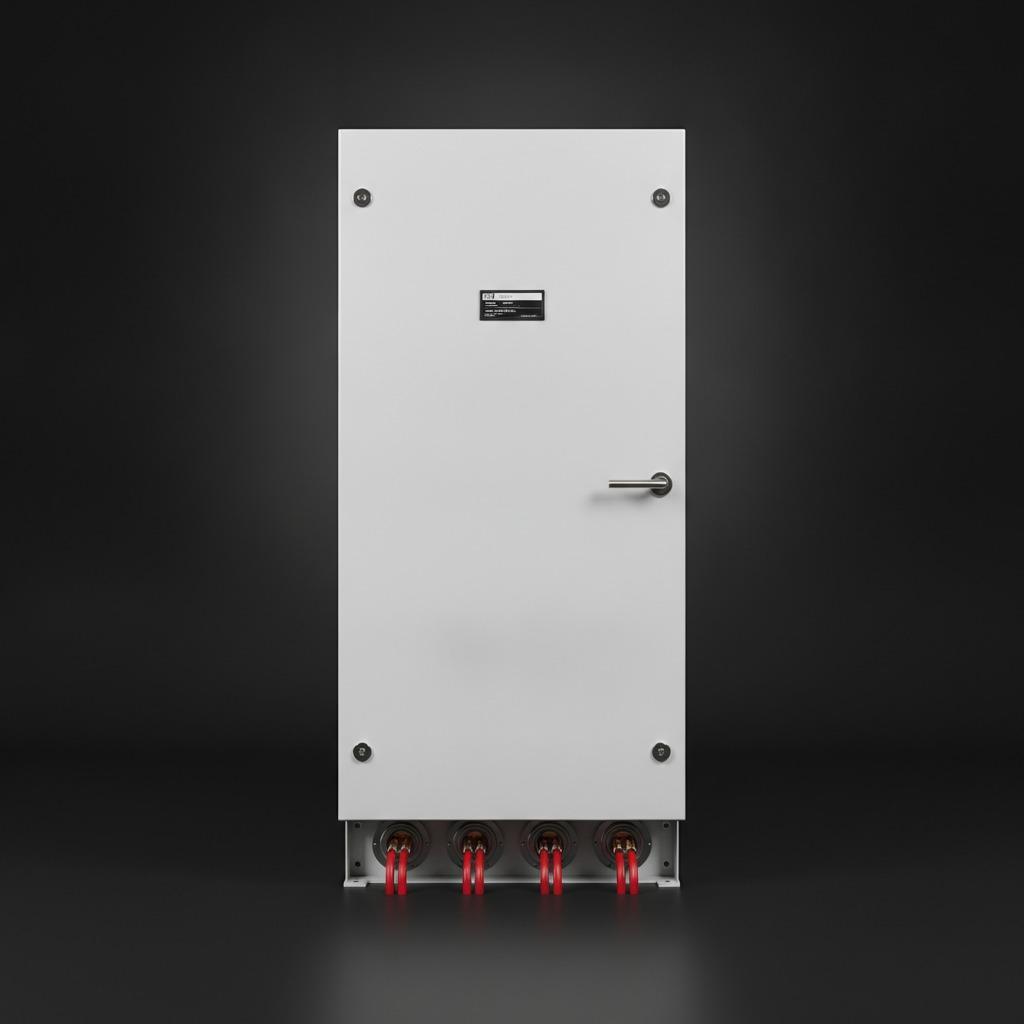
From the visible construction of a cabinet-style electrical assembly, several things are usually already clear. A white painted metal housing with a flat front face suggests a machine-built assembly intended for protected installation rather than a consumer product. The presence of four recessed rectangular handle or latch assemblies on the front, arranged in a 2×2 pattern, points to a design that expects repeated access. That matters for maintenance-heavy systems.
Multiple cable glands and external power cables at the bottom edge indicate that the unit is not a sealed, stand-alone block with no external interfaces. It is meant to connect into a larger electrical system. In practice, that often means the enclosure is doing at least three jobs at once: protecting internal components, organizing wiring, and presenting a serviceable front or access plane for technicians.
One practical caution: when buyers see a compact vertical enclosure, they sometimes assume the internal layout is simple. It may not be. A dense battery or control assembly can hide a lot of thermal and wiring complexity behind a neat front panel. That is why enclosure design should be reviewed alongside the electrical architecture, not after it.
Lithium battery formats used in industrial equipment
The term lithium battery covers more ground than many procurement documents admit. In industrial products, the most common discussion points are not just the chemistry but the physical format and integration method. A lithium polymer battery, for example, is often selected when thin profiles or flexible form factors are useful. A LiPo battery is generally discussed in similar terms, though in buyer language the two phrases are often used interchangeably.
For industrial systems, the choice of battery type depends on the application envelope: runtime, discharge behavior, physical footprint, temperature exposure, and serviceability. A battery pack integrated into a sheet-metal enclosure may be configured very differently from a removable module or a simple standalone battery carton. That means the buying conversation should include the enclosure, wiring harness, and protection features—not just the battery cells themselves.
In a cabinet with power cables exiting through the lower edge, the battery may be part of a larger electrical assembly rather than a consumer-style replacement pack. That usually shifts the focus toward integration quality. Are the conductors supported properly? Are the cable exits protected against abrasion? Is there enough room for routing and strain relief? These are the questions that determine whether the assembly is appropriate for industrial service.
Key reference points for evaluating a lithium battery assembly
If you are comparing battery assemblies or custom electrical enclosures, it helps to separate the evaluation into a few practical categories.
1. Mechanical protection
The enclosure should shield the internal battery or control components from casual impact, handling damage, and environmental exposure consistent with the application. A cabinet with a rigid sheet-metal body and integrated latch points is usually aimed at this goal. The buyer should still confirm the actual use conditions, because “robust-looking” is not the same as verified suitability.
2. Cable management
External cable exits are useful, but only if they are managed properly. Multiple power cables emerging from the bottom edge suggest a system that connects to other equipment or a distribution network. The quality of the gland arrangement, routing discipline, and strain relief will affect reliability more than many teams expect. This is one of those areas where a tidy sample often tells a better story than a spec sheet.
3. Service access
The four front latches imply repeated opening and closing. That can be a good thing if the internal design supports maintenance, diagnostics, or battery replacement. It can also be a warning sign if the assembly is opened often but not designed for durable service cycles. Ask how frequently the enclosure is expected to be accessed and what parts are considered field-replaceable.
4. Integration clarity
A battery assembly that is built into a control or power enclosure should come with clear drawings and wiring identification. Without that, procurement teams can end up with a technically capable unit that is difficult to install. For custom builds, documentation is not paperwork; it is part of the product.
When lithium polymer battery construction makes sense
A lithium polymer battery or LiPo battery is often discussed when the design needs packaging flexibility, lower profile geometry, or a custom-shaped energy source. In industrial contexts, that can be useful in compact assemblies where the enclosure is constrained by machine frame dimensions or where the available volume is irregular.
That said, format should not be chosen on packaging convenience alone. Buyers sometimes like the idea of a slim battery pack, then discover later that the real system needs better thermal spacing, different connector placement, or easier replacement access. The enclosure in the image suggests a housed, integrated assembly, which is exactly the sort of situation where cell format, thermal design, and service strategy have to be considered together.
For sourcing managers, the practical question is simple: does the chosen battery format fit the mechanical enclosure without forcing compromises in wiring, maintenance, or protection? If the answer is unclear, the project needs more engineering review before a purchase order is issued.
Common mistakes buyers make with battery-enclosed assemblies
One common mistake is treating the cabinet as a generic box and the battery as the only critical item. In reality, the cabinet design can make or break the system. A well-made battery pack in a poorly designed housing can be harder to service and less reliable than a more modest pack in a disciplined enclosure.
Another mistake is underestimating the importance of cable exits. Red insulated power cables exiting the lower edge of an enclosure tell you the system depends on external connectivity. If the cable path is not well protected, vibration and repeated handling can cause wear over time. That kind of issue rarely shows up in the first acceptance check.
It is also easy to over-specify on paper and under-specify in practice. Teams ask for “industrial-grade” without defining temperature range, vibration expectations, access frequency, or mounting conditions. A useful buyer brief should describe the operating environment in plain terms. Indoor cabinet? Mobile machine? Stationary energy module? Those details change the design.
What to ask a supplier before you approve a custom enclosure battery unit
Ask for the internal layout drawing, not just the outside dimensions. If the assembly is custom, the internal arrangement matters as much as the outer shell. Ask how the cables are supported and whether strain relief is part of the build. Ask what service actions are intended through the front access points. If the unit uses a lithium polymer battery or another lithium battery format, confirm how the battery is protected inside the housing and how replacement is handled if that becomes necessary later.
It is also reasonable to ask whether the enclosure is intended for machine control, energy storage, or another electrical application. The answer should guide your inspection criteria. A control enclosure and a battery enclosure may look similar from the outside while having very different requirements inside.
One useful buyer-facing warning: do not let a clean sheet-metal finish distract you from the fundamentals. Paint quality is nice, but wiring discipline and access design are more important to long-term performance.
FAQ
Is a lithium battery always the same as a LiPo battery?
Not exactly. In everyday buyer language, the terms are often used loosely, but they can refer to different interpretations of lithium-based battery construction. For procurement purposes, what matters most is the actual chemistry, format, and integration requirement stated in the technical documents.
Why do industrial battery assemblies use metal enclosures?
Metal enclosures offer mechanical protection, support mounting, help organize wiring, and create a more serviceable assembly for equipment use. They are common in industrial power systems and control cabinets for those reasons.
What should I inspect first on a sample unit?
Start with cable exits, latch quality, and access method. Then look at how the wiring is routed and whether the enclosure seems designed for repeated service. Those details usually reveal the overall build philosophy faster than cosmetic inspection.
A practical next step for engineering and sourcing teams
If you are evaluating a lithium battery assembly for industrial use, treat the enclosure as part of the product definition, not packaging after the fact. Confirm the battery format, the cable interface, the access strategy, and the mechanical protection level before you compare suppliers. That approach saves time and avoids the common trap of buying a technically acceptable battery that turns into a difficult field installation.
For custom electrical enclosure assembly, sheet-metal fabrication, and wiring harness integration projects, the right question is not only whether the battery works, but whether the full assembly will work in the machine, in the cabinet, and in the hands of the people who have to maintain it.