
Why a display rack is more than “just a shelf”
A display rack does a job that sounds simple until you have to live with the results. It holds product, guides attention, and shapes how a space feels. In a retail setting, the wrong unit can make merchandise look crowded or forgettable. In an office, the wrong unit can turn storage into visual noise. And in a workshop, an unstable rack becomes a constant irritation. That is why buyers looking for a display rack should think beyond capacity alone and pay attention to structure, finish, openness, and how the unit supports the items placed on it.
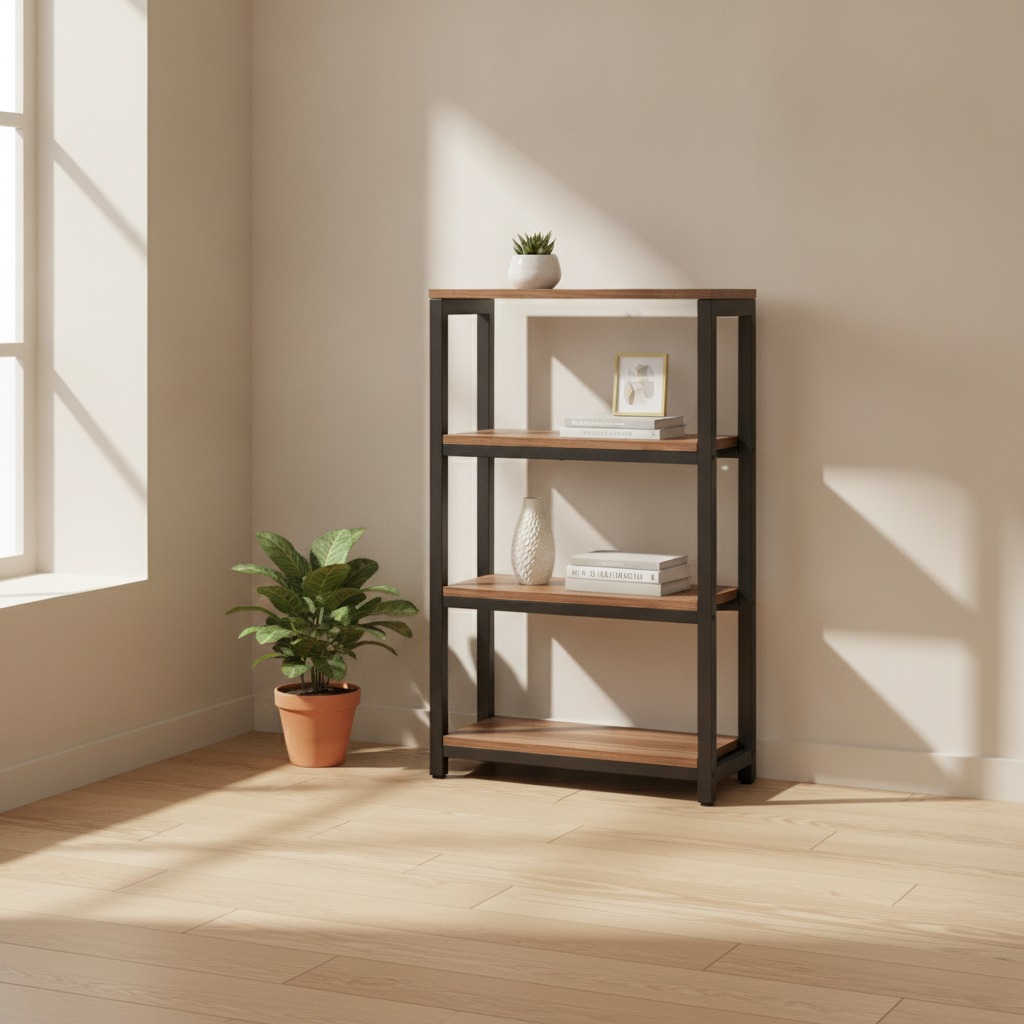
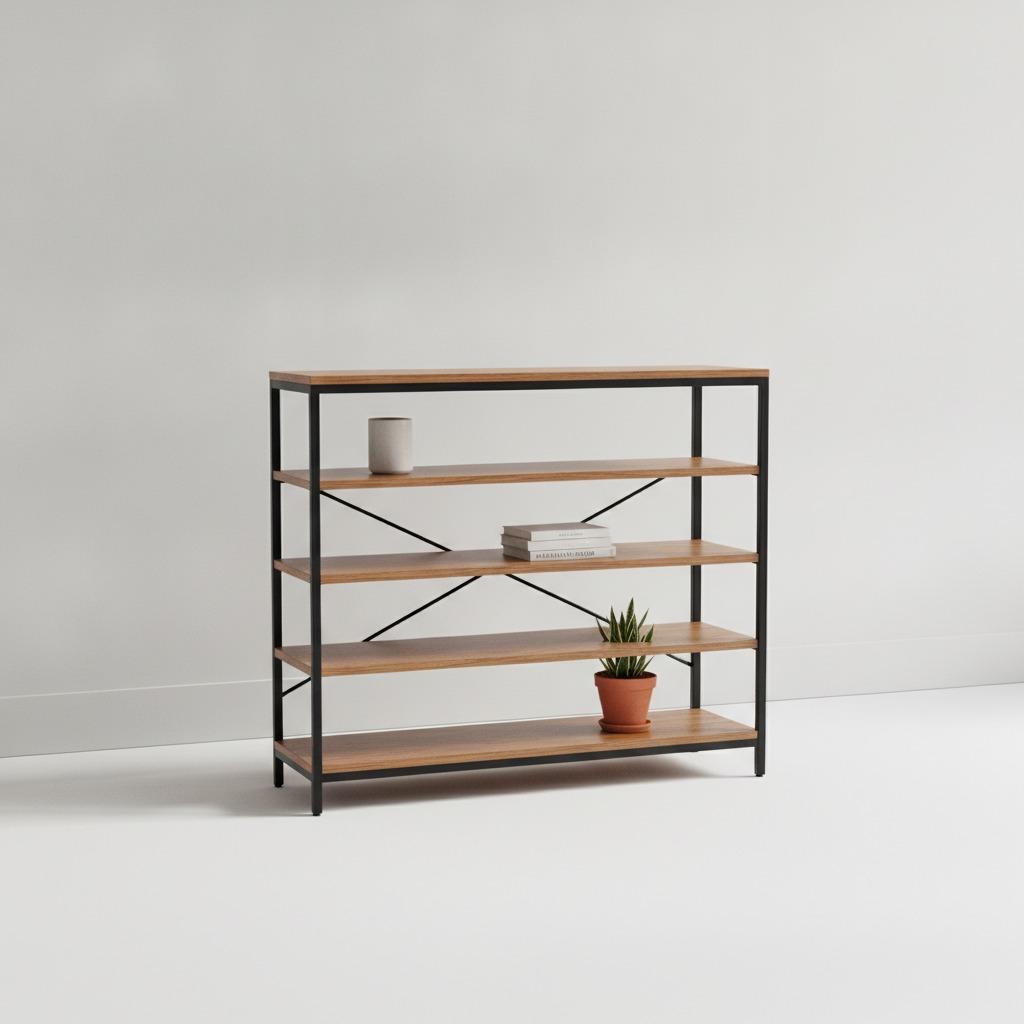
The open shelving unit described here sits somewhere between furniture and functional fixture. With a black metal rectangular frame and four wood-look shelf boards, it is visually restrained but practical. That combination is useful in places where the rack should disappear just enough to let the contents stand out. It can serve as a store display stand, a merchandise display rack, or simply a freestanding organizer for mixed-use spaces. The decision most buyers are really making is whether they want something that only stores items, or something that also helps present them well.
What this style of rack is good at
Open shelving has one obvious advantage: visibility. You can see what is stored, reach it quickly, and change the arrangement without fighting doors or closed compartments. That matters in retail, where quick merchandising changes are routine, and it matters just as much in a home office or garage where access is part of the value. A rack like this is not trying to hide content. It is trying to organize and display it with a clean silhouette.
The visible construction also tells you a lot about likely use. A black metal frame suggests stiffness and a straightforward load path. The wood-look shelf boards soften the industrial feel and make the unit suitable for customer-facing spaces, not just back-of-house storage. Four shelf levels give enough separation for books, packaged goods, decor, or tools without making the rack feel cramped. Because the design is open-backed and open-sided, it can work against a wall or in a room where the rear face is not meant to be decorative.
Quick buyer takeaway: choose by use case, not by appearance alone
If you are comparing a display rack to a closed cabinet or a heavier industrial rack, ask one simple question: what needs to be seen, reached, and rearranged often? If the answer is “almost everything,” open shelving is usually the better fit. If the answer is “items must be hidden, locked, or dust-protected,” you probably need another solution.
That sounds obvious, but buyers still get it wrong. A beautifully styled retail display stand can fail if it cannot support the category mix. A shop fixture that looks strong but is visually bulky can crowd a narrow aisle. A home buyer may choose a unit for style and only later discover that the proportions do not suit books, bins, or décor. The right merchandise display rack should solve both presentation and practical storage in the same footprint.
Construction details that matter in real use
The visible structure here is a rectangular metal frame with horizontal cross members and vertical side supports. In manufacturing terms, that points to an assembled furniture format built from a welded or fastened frame paired with cut shelf panels. The exact process is not stated, so it is better to treat the unit as a general-purpose composite construction rather than assume a specific joinery method. Still, the design gives a few important clues.
Metal frame
Black metal frames are favored because they offer a strong visual outline and usually tolerate daily handling better than fully painted softwood. Matte or semi-matte black also reduces glare, which helps in stores and offices. A caution, though: finish quality matters. In a rack that will be moved often, scuffs and corner wear show up quickly on darker coatings.
Wood-look shelves
The shelf boards appear to be engineered wood or a laminated wood-composite panel, but the exact material is not visible. That distinction matters because buyers often assume “wood look” means real wood veneer, which may not be the case. For general display and storage, a stable composite panel is often perfectly adequate. What matters more is whether the shelf surface resists everyday abrasion, cleaning, and edge damage. Retail buyers should be especially cautious here if the display will carry products with sharp packaging corners or heavy labels.
Open geometry
Four straight, rectangular shelves create a predictable layout. That is useful for merchandising because you can build a visual rhythm: tall items on one level, grouped smaller items on another, a facing row of products at eye level, and reserve lower shelves for bulk or backup stock. In a home setting, the same geometry keeps books and bins from looking improvised. There is nothing fancy about the shape, which is exactly why it works.
Where this rack fits best
This type of rack is versatile enough to bridge several environments, but it is not equally ideal everywhere. In a living room, it can hold books, framed objects, and baskets without overpowering the room. In a home office, it becomes a practical back wall for paperwork, reference materials, and office supplies. In a bedroom, it can store folded items or decor. In a garage or workshop, it can hold light-duty tools, labeled boxes, and hardware bins.
For small retail, the appeal is obvious. A store display stand with open shelves allows staff to rotate stock and create seasonal arrangements without special hardware. It can also help break up a wall or create a product zone without installing permanent fixtures. That said, retailers should think carefully about what the rack is carrying. A merchandise display rack for packaged accessories is one thing; a unit for dense, heavy inventory is another. Open shelving is forgiving in layout, not in physics.
Selection criteria buyers should not skip
Because the visible description does not provide exact dimensions, load rating, or assembly details, buyers should ask for those before committing. This is especially important if the rack will be used in a commercial or semi-commercial environment. A clean appearance is not proof of structural adequacy.
Start with proportion. Measure the floor space, the ceiling height, and the size of the items you expect to display. A display rack that is too tall for a room can look awkward and make stocking difficult. One that is too shallow may not handle larger books, storage bins, or product cartons. Then look at shelf spacing. Four shelf levels may suit many uses, but if your items are unusually tall, fixed spacing can become a limitation.
Next, consider stability. Freestanding open racks should sit level and feel composed under normal handling. If you expect the unit to be placed in a traffic-heavy retail area, ask about anchoring options or wall restraint. This is a practical caution rather than a dramatic one: many rack problems are simply the result of being used in more active settings than the design intended.
Finally, match finish to environment. Black metal and wood-grain shelves work well in mixed-material interiors, but the same look may be less suitable in a purely clinical, dust-sensitive, or highly regulated space. The best-looking display rack is not always the best operational choice.
Common mistakes when buying a display rack
One common mistake is buying for the product catalog, not the actual merchandise. A rack may look ideal in a staged photo, then fail once real inventory arrives in varied sizes. Another is ignoring access. If staff need to restock frequently, deep shelves can become inefficient even if they look good from the front.
Another error is overestimating how much visual weight a unit can carry. Open shelves make items visible, but they also expose clutter. A poorly arranged rack can make a space look busier than it is. This is where a store display stand earns its keep: not by filling space, but by framing the merchandise so the arrangement feels intentional.
Buyers also sometimes focus only on material words like “metal” and “wood.” Those labels are too broad. You need to know whether the shelf panels are real wood, veneer, laminate, or another coating, and whether the frame is merely finished in black or built from a specific metal gauge. Those details affect durability, repairability, and how the rack ages.
Practical advice for sourcing teams and product teams
If you are sourcing this style of merchandise display rack for multiple sites, standardization matters. Keep the same visual family across locations, but verify that the unit meets the use case in each one. A rack for office décor does not necessarily suit a warehouse aisle, even if the silhouette is the same. It is often smarter to define the rack by environment: customer-facing display, mixed storage, or light-duty utility.
Product teams should also think about the selling story. This type of rack sells on versatility, clean lines, and easy integration with different interiors. That is a stronger angle than trying to position it as heavy-duty equipment. The product is more credible when described as an open shelving solution for display and organization than when overpromised as a universal storage fix.
FAQ: a few questions buyers usually ask
Is this only for retail?
No. It can work in retail, but also in home offices, living rooms, bedrooms, garages, workshops, and light-duty storage areas.
Can it replace a cabinet?
Not really. A display rack is for visibility and access. A cabinet is for concealment and protection.
Is the shelf surface definitely real wood?
No. The visible information suggests a wood-look panel, but the exact material is not confirmed.
Should I use it free-standing in a public area?
Only after checking stability, footprint, and whether anchoring is needed for your environment. In busier spaces, that check is worth the time.
A sensible next step
If you are evaluating a display rack for a store, office, or utility space, start with the real job it needs to perform. Decide whether the priority is presentation, access, storage, or all three. Then request the missing specifications before approving a purchase: dimensions, shelf capacity, panel material, assembly method, and any stabilization options. A well-chosen rack does not just hold items. It makes the space easier to work in and the merchandise easier to understand.
That is the standard worth holding, especially when the rack will be used every day.