
What buyers really need to know when they look at a battery label
A Battery is often treated as a simple commodity until it causes a starting failure, a downtime complaint, or a packaging headache in production. For engineers, sourcing managers, and product teams, the real question is rarely “What is this?” It is more often “Will this unit deliver the right current, fit the application, and avoid surprises after purchase?”
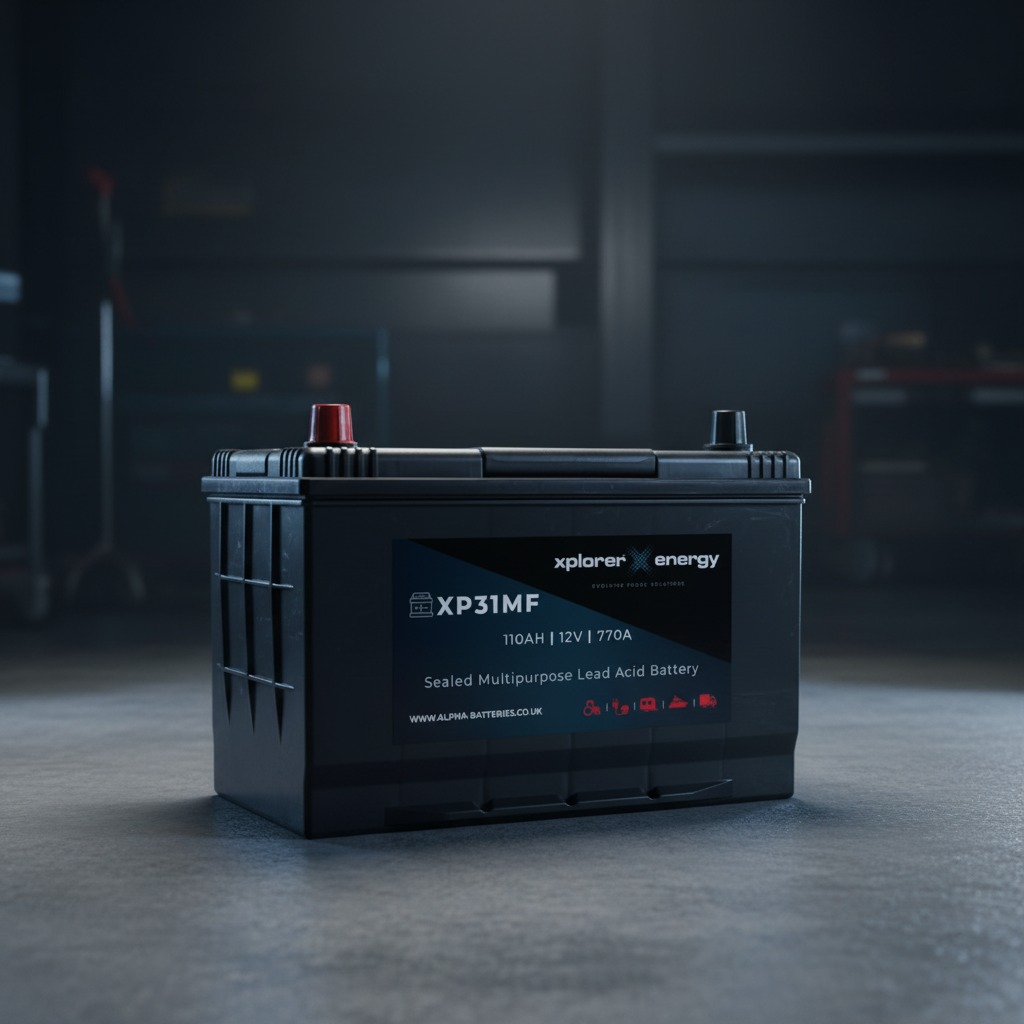
The visible product here is a sealed multipurpose lead-acid battery in an automotive-style format, marked XP31MF, 12V, 110Ah, and 770A under the Xplorer Energy brand. That combination points to a high-demand electrical storage unit designed for starting and power supply in vehicles or other DC applications. The chemistry is lead-acid, but the internal subtype is not visible, so it is best not to assume AGM, gel, or flooded construction just from the exterior.
That may sound like a small distinction, but in procurement it matters. A battery that is technically “12V” can still behave very differently depending on its current delivery, footprint, maintenance profile, and charging expectations. Buying teams that focus only on voltage often learn this the hard way.
Quick read on the visible specifications
On the label, the most useful decision-making data are straightforward:
12V tells you the nominal system voltage. 110Ah suggests a relatively large energy-storage capacity for a unit in this class. 770A indicates strong starting or high-current capability, which is often the number that matters most in cold starts or heavy electrical demand. The model code XP31MF helps identify the product, although fitment still cannot be confirmed from the label alone.
For buyers, the key takeaway is that this is not a small auxiliary battery. It is a substantial sealed lead-acid unit intended for applications that need both reserve capacity and high starting current. That makes it relevant to cars, vans, leisure vehicles, backup power setups, and some equipment that operates on a 12V DC platform.
Why the difference between types matters in procurement
Lead-acid batteries remain common because they are familiar, rugged, and relatively easy to source. But the category is broader than many buyers assume. Two products may look nearly identical from the outside and still differ in internal plate design, maintenance behavior, and suitability for vibration, cycling, or standby use.
That is why a careful buyer should separate the visible facts from the inferred ones. The visible facts here are clear: sealed construction, rectangular automotive-style case, top posts, red positive cap, black negative cap, and a matte-to-semi-gloss dark plastic housing. The unknowns are also important: exact dimensions, weight, AGM or gel configuration, mounting orientation limits, and charging requirements. None of those should be guessed.
In sourcing terms, this is a reminder that the label is only the beginning of the qualification process. If you are buying for a fleet, a product platform, or a replacement program, you still need compatibility data from the supplier or the vehicle/equipment spec sheet.
How this battery format is typically used
The box-style casing and top-post terminals are consistent with automotive and light industrial battery layouts. In practical use, that means the battery is likely intended to provide strong short-duration power for starting, while also supporting electrical loads when the engine or primary source is not running.
That combination is important in several common scenarios:
Vehicle starting systems that need high cranking power. Leisure vehicles and recreational equipment that need a dependable 12V supply. Backup or standby systems where a sealed battery is easier to manage than a more exposed format. Other DC equipment where both capacity and high discharge current matter.
Still, one caution is worth repeating: visible form factor does not confirm exact vehicle compatibility. Terminal geometry, case dimensions, hold-down style, and polarity orientation all need verification before a buyer treats it as a drop-in replacement.
What engineers and sourcing teams should compare before buying
If you are comparing this Battery against another option, do not stop at the headline numbers. The right decision usually comes from checking five practical points.
1. Voltage match
12V systems are common, but they are not universal. Match the battery to the system architecture first. This sounds obvious, yet mismatched voltage remains a basic and expensive mistake.
2. Current demand
The 770A rating suggests strong starting performance. That matters in cold weather, heavy engine loads, and equipment that draws a hard initial surge. If the application needs high cranking current, a lower-rated replacement may work on paper and fail in the field.
3. Capacity reserve
The 110Ah marking suggests meaningful reserve capacity. For buyers, this can matter in applications with accessories, intermittent use, or standby periods. It is not just about starting the machine once; it is also about how long the system can remain usable under load.
4. Physical fit
Even a technically compatible battery becomes useless if the case does not fit the tray or the terminals do not align properly. The product image shows a standard rectangular enclosure with molded side ribs, but exact dimensions are not provided. Those must be confirmed before purchase.
5. Service model
Because this is described as a sealed multipurpose lead-acid battery, buyers should clarify whether the unit is maintenance-free in the way their team expects. “Sealed” can be used broadly in the market, and not every sealed battery behaves exactly the same in service. It is worth asking for the supplier’s definition.
Lead-acid versus rechargeable battery and lithium battery options
When people search for Battery products, they often compare lead-acid designs with a rechargeable battery or a lithium battery alternative. That comparison is valid, but it should be done on use case rather than fashion.
Lead-acid units like this one are widely used because they are familiar, robust, and generally well understood by installers and service teams. They are also often easier to integrate into legacy 12V systems. A lithium battery may offer different weight and cycle-life advantages depending on the design, but it can introduce charging, protection, and system-compatibility requirements that are not trivial.
For a sourcing manager, the better question is not which chemistry is “better” in the abstract. It is which battery aligns with the electrical system, service environment, and replacement expectations. If the platform was designed around lead-acid behavior, switching chemistries without checking the charger and control logic can create new problems.
Common buyer mistakes that lead to returns
The most common mistake is buying by nameplate alone. A 12V, 110Ah battery with a 770A rating sounds broadly suitable for many applications, but a broad match is not a qualified match.
Another mistake is assuming all sealed batteries are maintenance-free in the same way. Buyers should ask whether the unit has any special storage, charging, or orientation requirements. If that information is missing, it should be requested before the order is placed, not after the pallet arrives.
A third issue is ignoring terminal arrangement. The product clearly has top posts with red and black caps, which is helpful, but it does not settle the question of post standard or exact polarity layout for every application. In replacement buying, that detail can decide whether a battery is usable without modification.
Finally, do not assume that one battery labeled for automotive-style use is automatically suitable for deep-cycle service. Starting batteries and deep-cycle batteries are not interchangeable just because both are 12V and lead-acid.
Practical advice for teams specifying this kind of battery
If you are writing a spec, the cleanest approach is to define the electrical and physical requirements separately. Start with voltage, capacity, and current demand. Then add case style, terminal style, polarity, and any mounting constraints. If the application is sensitive, include acceptable chemistry and service behavior as well.
For purchasing, request the manufacturer’s datasheet rather than relying on the front label. A product like this can be perfectly ordinary in appearance and still differ in the details that matter most to installation and service teams. That is especially true when exact dimensions, terminal standards, and subtype details are not visible.
If your application involves backup power or infrequent use, storage conditions matter too. Lead-acid batteries do not like neglect. Even without quoting a specific charging regime, it is safe to say that proper maintenance and compatible charging practices will affect real-world performance. That should be part of the buying conversation, not an afterthought.
FAQ
Is this a car battery?
It appears to be automotive-style and may be used in cars, vans, or similar 12V systems, but exact vehicle fitment is not confirmed by the image or label alone.
Is it a rechargeable battery?
Lead-acid batteries are rechargeable by design. The exact charging profile should still be confirmed with the supplier or system documentation.
Can I assume it is AGM or gel?
No. The internal construction is not visible, and the provided data do not confirm AGM, gel, or flooded configuration.
What should I ask the supplier before ordering?
Ask for dimensions, terminal standard, polarity layout, subtype, mounting guidance, and any storage or charging requirements. Those details are often more important than the model name alone.
Where this product fits in a buying decision
This Xplorer Energy battery sits in a familiar but important segment: sealed lead-acid power for starting and general 12V use. For many buyers, that is exactly the right kind of product because it balances capacity, starting current, and straightforward integration. For others, especially those considering a lithium battery migration, it may serve as the baseline for comparison.
The decision is less about marketing language and more about system fit. If the application needs a 12V sealed battery with strong current delivery and a conventional automotive-style layout, this is the kind of unit that belongs on the shortlist. If the application has unusual space constraints, cycling demands, or charger limitations, more specification work is needed before purchase.
That is the practical place to stop and verify, not to guess. A battery may look simple on the outside, but in the field it is one of the components most likely to punish vague sourcing.
Next step for buyers
Before placing an order, collect the datasheet and confirm the exact fitment requirements for your vehicle or equipment. If you are comparing this Battery against a rechargeable battery or lithium battery alternative, line up the comparison on voltage, current, physical size, and service behavior rather than chemistry alone. That is the fastest way to avoid a return, a mismatch, or an avoidable maintenance issue later on.