
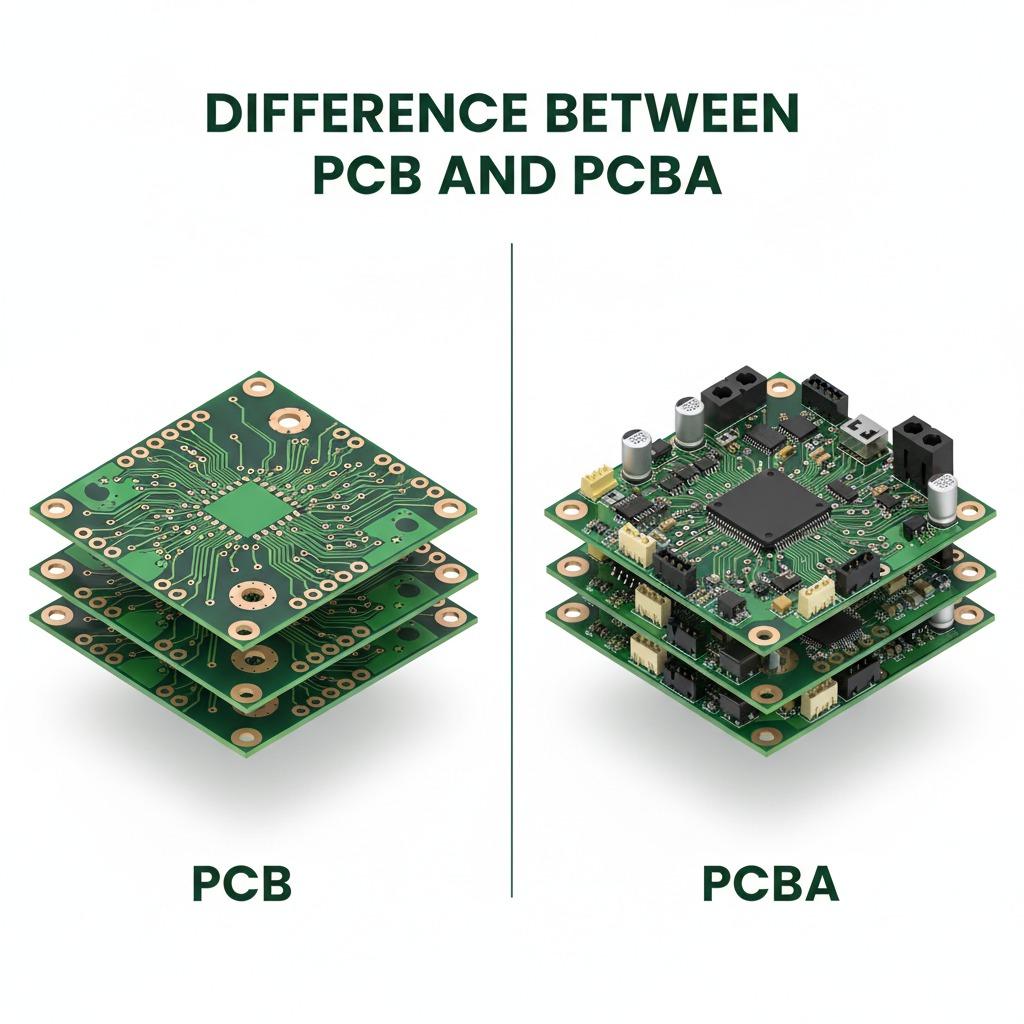
PCBA: what it is, why it matters, and where buyers usually get tripped up
When engineers and sourcing teams talk about pcba, they are usually talking about the point where a bare printed circuit board stops being a platform and starts behaving like a product. That distinction sounds simple until a project slips from board fabrication into assembly, and suddenly the real questions appear: which parts are fitted, how they are soldered, what inspection is needed, and whether the assembly is ready for test or only halfway there. For anyone responsible for product launch, cost control, or supplier qualification, PCBA制造 is not just a manufacturing step; it is where design intent becomes something you can power on.
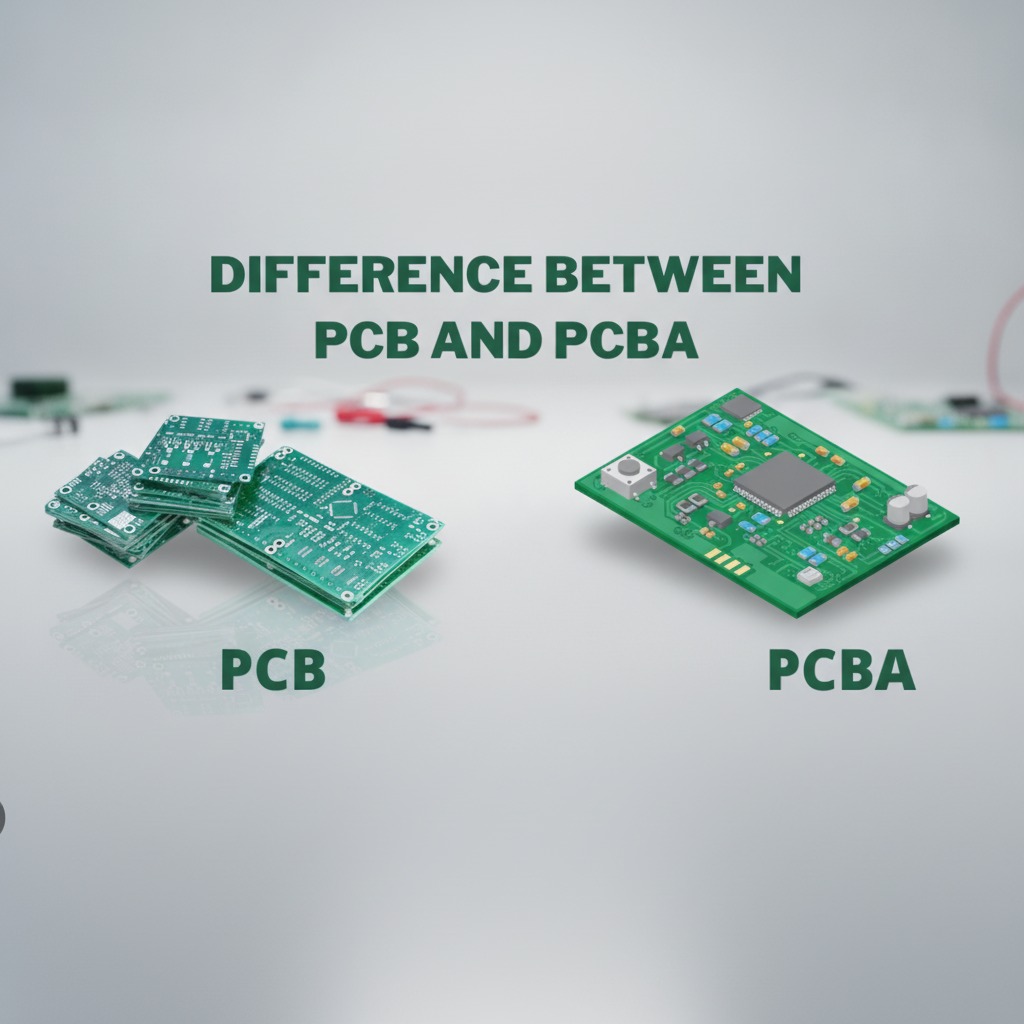
The image comparison between PCB and PCBA makes the difference easy to see. On the left, the bare board is a structure of traces, plated holes, pads, and a green solder mask. On the right, the same kind of board becomes a populated assembly, with integrated circuits, passives, connectors, a tactile pushbutton, and visible solder joints. That visual contrast captures the real purchasing decision: do you need fabricated boards only, or do you need a functional electronic assembly that is closer to final product form?
Quick reference: PCB vs. PCBA
A PCB is the foundation. It provides mechanical support and electrical interconnection, but it does not do the work by itself. A PCBA is a PCB with components mounted and soldered in place, so it can carry out a circuit function once powered and integrated into a larger system.
For buyers, this difference affects the entire supply chain. PCB sourcing is usually about laminate selection, layer structure, drilling, plating, solder mask, and surface finish. PCBA sourcing adds part procurement, stencil and solder paste control, SMT placement, reflow or wave soldering, through-hole assembly if needed, and inspection. In practice, assembly introduces more variables, more traceability questions, and more opportunities for delay if the bill of materials is incomplete or a part becomes obsolete.
What the board details tell you
The boards shown have the familiar green solder mask associated with many FR-4-class designs, although the exact substrate is not confirmed. That matters because the visible finish suggests a mainstream electronics build rather than a specialized high-frequency or metal-core application. You can also see plated vias, copper traces, drilled mounting holes, and metallic pads. These are the fingerprints of standard PCB fabrication.
On the assembled board, the component mix suggests a practical control or embedded system rather than a decorative electronics demo. There are integrated circuits, small passive parts, a pushbutton, and connector-style parts. The solder joints are visible, which is useful from a buyer’s point of view because it reminds you that assembly quality is not abstract; it is sitting in plain sight on every pad and lead. In real projects, that visible workmanship often foreshadows how the board will behave under vibration, thermal cycling, or repeated handling.
Why the PCB-to-PCBA handoff is such a sensitive stage
Many project problems begin at the handoff between fabrication and assembly. A board can be perfectly fabricated and still fail as a PCBA if the footprint library is wrong, the polarity markings are unclear, or the BOM includes parts with poor availability. The bare PCB can tolerate a few drawing ambiguities; assembly is less forgiving. Once metal and solder enter the picture, every mismatch becomes physical.
That is why sourcing managers often need to think beyond unit price. A low-cost PCB quote may be attractive, but if the downstream assembly process is unstable, the apparent savings evaporate quickly. The same caution applies to component supply. A PCBA order is not simply “board plus parts.” It is a coordinated manufacturing job involving procurement, placement accuracy, soldering profile control, and final testing. If one piece is weak, the whole schedule feels it.
Common manufacturing steps in PCBA制造
1. Fabrication of the bare board
The process usually starts with PCB fabrication: lamination, imaging, etching, drilling, plating, solder mask application, and silkscreen. The goal is to create a stable electrical platform with clean pads and consistent hole quality. If the base board is off, assembly will only magnify the defect.
2. Component sourcing and kitting
Assembly depends on accurate materials control. Components must match the BOM, and substitutions should be checked rather than assumed. This is where many teams lose time, especially if the design uses several package variants or parts with long lead-time risk. A compact board can still carry a surprisingly messy supply chain.
3. SMT and through-hole assembly
Surface-mount placement is the core of most modern pcba work. Paste is applied, parts are placed, and the board is soldered through a controlled thermal process. Some designs also require through-hole insertion, selective soldering, or mixed-technology assembly. The right method depends on connector style, mechanical loading, and the final environment.
4. Inspection and test
Inspection may include visual review, AOI, electrical test, or in-circuit and functional testing when the job calls for it. Buyers should be careful here: “assembled” does not automatically mean “verified.” A board can look complete and still contain a cold joint, a missing passive, or a polarity error that only shows up during test.
How to choose between bare PCB and full PCBA
The decision depends on where you want control to sit. If you are prototyping, have a strong internal assembly line, or need to validate only the board design, bare PCB procurement may be enough. If your team needs a quicker path to an operational unit, or if production consistency matters more than in-house handling, then PCBA is the more practical route.
For product teams, the real question is not whether the PCB exists. It is whether the assembly can be repeated without constant firefighting. Once you move into pilot builds, the value of a reliable PCBA supplier becomes much easier to see. They are not only placing parts; they are absorbing manufacturing complexity that your engineers may not have time to manage directly.
Selection criteria that matter in the real world
When evaluating a PCBA supplier, look at process discipline first. Ask how they handle part traceability, ESD protection, solder paste control, and rework documentation. Ask what inspection methods they use and whether they can support your board’s complexity. If the design includes dense routing, mixed packages, or mechanically loaded connectors, assembly capability matters as much as fabrication quality.
Also look at communication quality. A good supplier flags problems early: a footprint that looks off, a BOM item that is hard to source, a polarity mark that may be ambiguous, or a connector orientation that could cause assembly risk. That kind of practical caution is often more valuable than a glossy capability sheet.
Common mistakes buyers make
One frequent mistake is assuming the PCB design can move directly into assembly without a review. In reality, the assembly stage often exposes every small drafting shortcut. Another is neglecting component lifecycle risk. A board can be well designed and still become expensive if one key part is scarce.
Another buyer pitfall is underestimating the difference between prototype quantity and repeat production. A PCBA that works at low volume may still need process tuning before it can be built consistently at scale. That is normal, but it needs to be planned for. It is better to discover a soldering issue during a controlled pilot run than after hundreds of units are in transit.
Practical advice for engineers and sourcing teams
If you are preparing a build package, make sure your fabrication data and assembly data are equally complete. Gerber files alone are not enough for a PCBA order. You will usually need the BOM, centroid or pick-and-place data, assembly drawings, polarity notes, and any special handling instructions. The cleaner the package, the fewer surprises in the factory.
From a sourcing perspective, treat PCBA as a coordination job, not a commodity line item. The cheapest quote can hide the highest administrative cost if it leads to rework, line stoppage, or repeated clarification cycles. On the other hand, a supplier that asks disciplined questions early may save the program from a much larger problem later.
FAQ
Is PCBA the same as PCB?
No. A PCB is the bare circuit board. A PCBA is the assembled board with electronic components soldered onto it.
Can the same supplier handle both fabrication and assembly?
Often yes. Many manufacturers offer both PCB fabrication and PCBA services. That can simplify coordination, though buyers still need to confirm process control across both stages.
What should I check before approving a PCBA build?
Check the BOM, component availability, polarity markings, test requirements, and any mechanical constraints around connectors, buttons, and mounting holes. Those details tend to decide whether the build goes smoothly.
Why does assembly quality matter so much if the board already looks complete?
Because the visible finish is only part of the story. Hidden solder defects, part placement errors, and weak joints can affect reliability even when the board looks clean at a glance.
A sensible next step
If you are comparing options for a new design, start by separating the project into two questions: what must be fabricated, and what must be assembled. That simple split helps teams avoid a lot of confusion. For prototypes, a bare PCB may be enough. For a usable module, industrial control board, sensor interface, or embedded device, pcba is usually the step that turns the design into something you can ship, test, and support.
Before issuing a purchase order, review the build package one more time and make sure the supplier can support both the board and the assembly path. In manufacturing, the cleanest handoff is often the difference between a board that merely exists and one that actually performs.