
Why a window cleaning robot matters now
A window cleaning robot is no longer a novelty item for people who like gadgets. For many buyers, it has become a practical answer to a stubborn maintenance job: keeping glass clean without dragging out ladders, squeegees, spray bottles, and a fair amount of patience. That matters most in apartments with hard-to-reach panes, offices with wide glass fronts, and homes where exterior windows are awkward or unsafe to clean by hand.
The decision is not simply whether the machine works. It is whether the device fits the glass surfaces you actually need to maintain, whether it reduces labor enough to justify the purchase, and whether it can leave a result that looks clean rather than merely “less dirty.” That distinction is where many buyers get stuck. A robot for window cleaning sounds straightforward, but in practice the differences between suction, spray pattern, wiping pressure, and pad quality show up quickly on streak-prone glass.
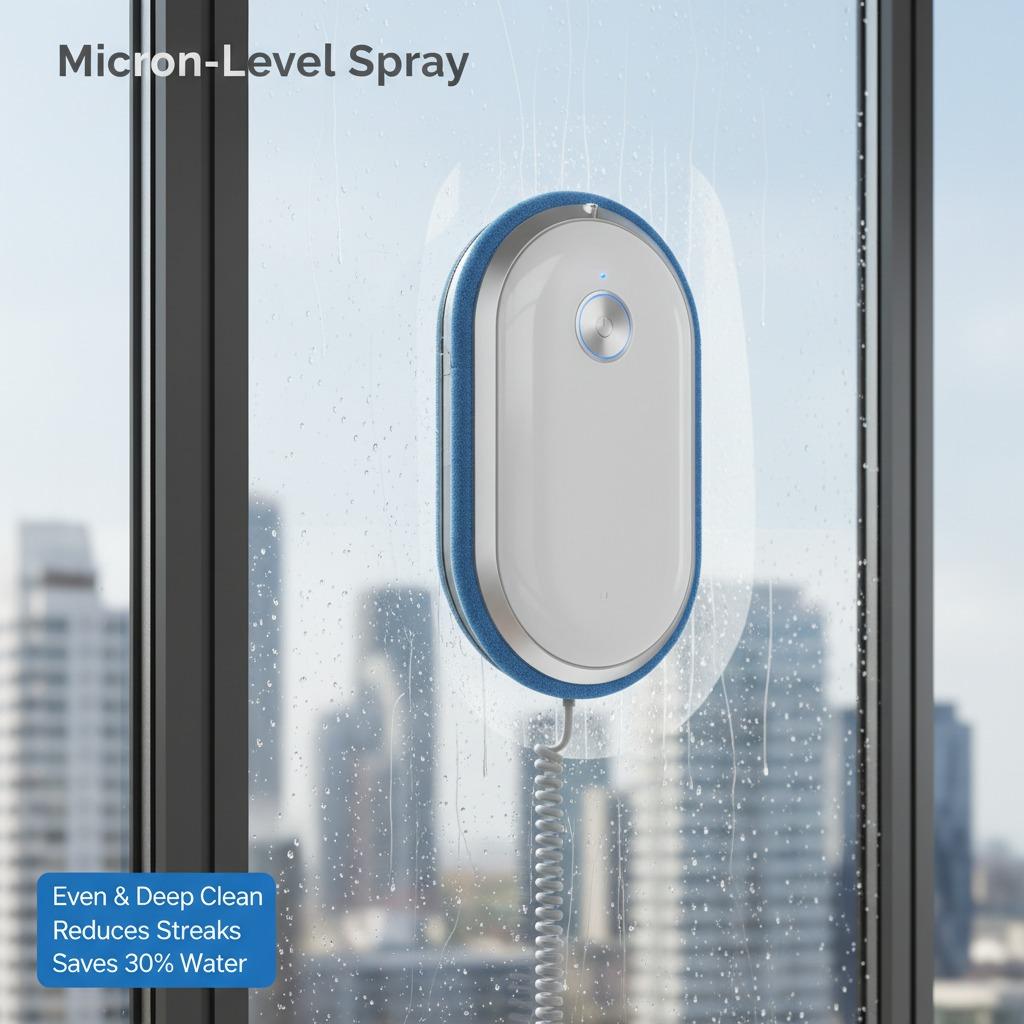
The model described here is a compact electric window-cleaning robot mounted on the inside of a window, with a rounded rectangular body, a visible side grille, a front sensor or button area, and a corded power connection. The product imagery also points to claims such as “micron-level spray,” “even & deep clean,” “reduces streaks,” and “saves 30% water.” Those are useful clues about how the device is being positioned, but they should be treated as marketing claims unless independently tested data is available.
What the buyer is really deciding
The basic question is not whether glass can be cleaned. It can. The real question is who should do it, how often, and under what conditions. For a sourcing manager, that may mean comparing a device against manual labor costs. For a product team, it may mean understanding user pain points around safety, convenience, and repeatable results. For an engineer, the interesting part is the interplay of motion, spray, wipe contact, and edge control.
A window cleaning robot offers value when one or more of these conditions are true:
The windows are large enough that manual cleaning is tedious.
The glass is high, external, or otherwise inconvenient to reach.
The application is routine, not occasional, so repeatability matters.
The buyer wants a compact appliance rather than a complicated cleaning rig.
The challenge is that glass cleaning is unforgiving. Any weakness in pad design, fluid distribution, or path control can leave visible trails. That is why the device’s mechanical simplicity is not the full story. What matters is how consistently the system handles dirt, dust, and dried spots without making the pane look worse in certain light.
What the visible product design suggests
Based on the visible product category, this appears to be a consumer electrical appliance built around a molded housing and a cleaning head with a gray textured microfiber-like ring around the perimeter. That kind of perimeter pad is a familiar approach in automated glass-cleaning devices because it allows the machine to contact the surface while moving across it, rather than relying on a single narrow wipe.
The silver-and-white body gives it a clean, domestic look, which matters in consumer channels and also in light commercial use where the device may be seen by customers or staff. The rounded rectangular shape is practical, too. It avoids sharp edges, leaves room for internal motors and pumping components, and usually makes the unit easier to position on flat glass.
The visible cord is worth noting. Corded operation is not glamorous, but it can be a real advantage for a window cleaning robot used on longer cleaning sessions. Buyers who want continuous runtime often prefer a cord over battery dependence, especially if the device is meant to handle several panes in one pass. Of course, cord management becomes part of the workflow, and that is one of those small annoyances that show up after the first week of use.
How these devices generally clean glass
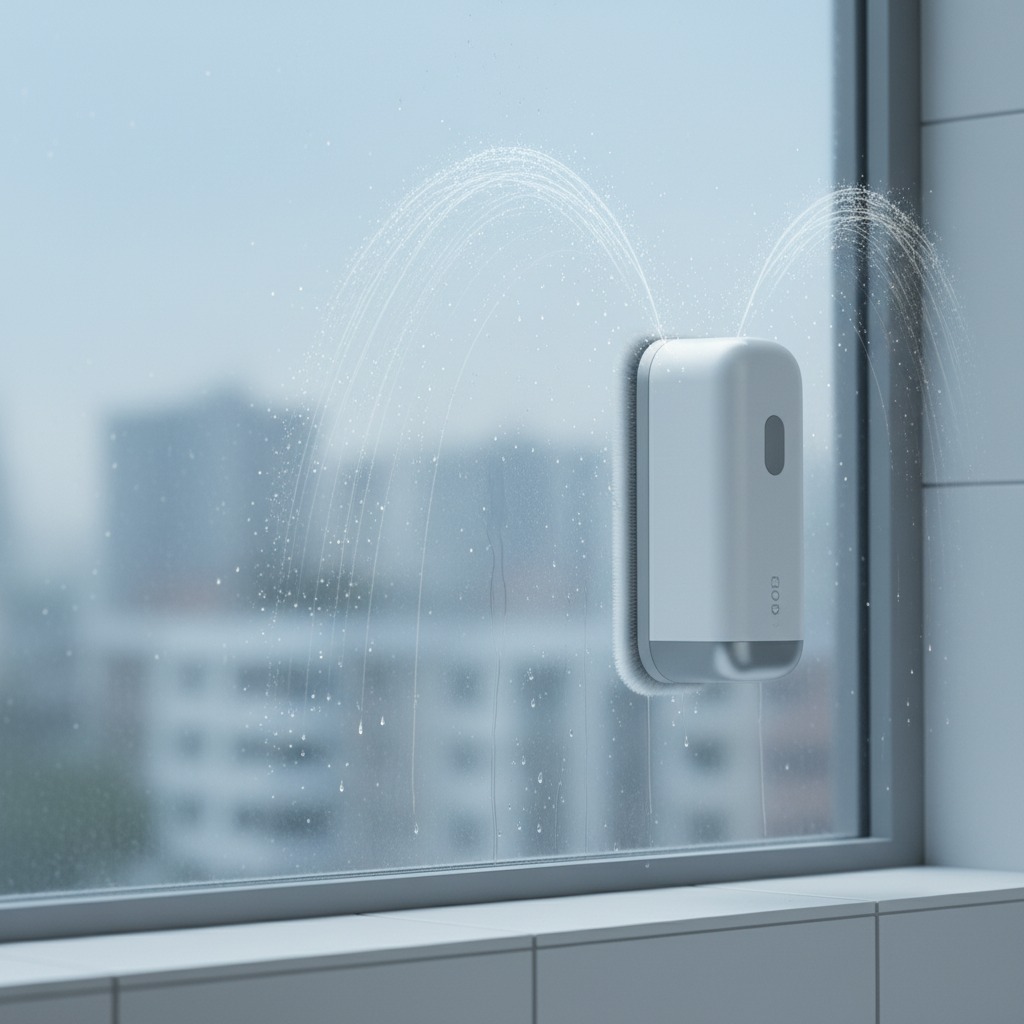
While the exact internal mechanism is not visible, products in this category usually combine motorized movement with a spray-and-wipe cycle. In plain terms, the machine wets the glass in a controlled way, then uses the cleaning pad to lift dust and smear-prone residue as it moves. The image claim of micron-level spray points to a finer misting approach, which is intended to distribute moisture more evenly and avoid over-wetting one section of the pane.
That balance matters. Too little spray and dry debris drags across the surface. Too much spray and the glass can look cloudy or streaked, especially under direct light. Buyers often underestimate how much the fluid pattern influences the final result. A good wipe pad can be undermined by poor spray control, and a good spray system can be wasted on a pad that loads up too quickly.
What “even and deep clean” usually means in practical terms
In buyer language, “even and deep clean” is usually shorthand for better coverage and fewer missed spots. It does not mean the machine removes every stain the way a hand scrub might on the first pass. Instead, it implies a more uniform cleaning path and a design aimed at reducing patchy results.
For light dust, fingerprint marks, and routine maintenance on household or office windows, that may be enough. For baked-on grime, tape residue, paint overspray, or construction dust, no compact appliance should be expected to behave like a specialist restoration tool. That is an important caution, because disappointment often comes from using the right machine in the wrong condition.
Key buying criteria for engineers and sourcing teams
If you are evaluating this type of product for procurement, retail, or product development, the most useful comparison points are the ones that affect day-to-day use rather than brochure language.
1. Cleaning consistency
Look at how the robot maintains contact with the glass and whether the cleaning pad design appears replaceable or washable. A microfiber-style perimeter ring is common because it can provide broad contact and a softer wiping action. But the real question is how it behaves after repeated use and whether the pad is easy to maintain.
2. Spray delivery
The product imagery suggests a fine spray concept. Buyers should ask whether the spray is distributed evenly across the cleaning path, whether it is controlled automatically, and how much fluid the device uses in typical operation. The “saves 30% water” claim is directionally interesting, but it should not be treated as a verified specification without test data.
3. Power architecture
The visible cord indicates corded operation, which can be a practical choice for steady runtime. For many users, that is more useful than a battery that forces mid-job charging. Still, the cord needs to be long enough for real-world window layouts, and the user experience depends on how cleanly the cable is managed around frames and corners.
4. Form factor and placement
The device is designed to sit on the inside of the window, which is useful for safety and access. That also means the window surface, frame shape, and edge clearance all matter. Not every pane is equally friendly to a mounted cleaning device, and buyers should check compatibility early rather than assume universal fit.
5. Maintenance burden
Any cleaning automation product eventually becomes a maintenance item itself. Pads need washing or replacement, spray paths need inspection, and the housing should be easy to wipe down. A device that cleans glass well but takes too long to keep clean becomes awkward fast.
Common mistakes buyers make
The biggest mistake is buying on promise rather than application. A polished device with strong visual marketing can look like a universal fix, but glass cleaning is not universal. Frosted glass, textured panes, heavily soiled exterior windows, and irregular frame geometries can all change the result.
Another mistake is ignoring the aftermath of use. Buyers often focus on the pass itself and overlook what happens when the job is done: pad cleaning, cord storage, and how often the machine needs attention. Those details sound small. They are not.
There is also a tendency to overestimate what automation means. A window cleaning robot can reduce manual effort, but it may still require supervision, setup, and occasional spot cleaning on stubborn areas. In other words, it changes the work; it does not erase it.
Where this type of product fits best
This category is strongest in household windows, apartment glass, office interiors, and light commercial environments where glass surfaces need regular upkeep. It is especially appealing where safety or access makes manual wiping inconvenient. For property managers and facilities teams, the machine may be less about full replacement of cleaning labor and more about reducing repetitive work on straightforward panes.
The compact shape is also a plus for storage. Unlike bulkier floor equipment, this kind of device can live on a shelf or in a janitorial cabinet and come out when needed. That practical, everyday usability often decides whether the product gets used regularly or ends up forgotten after the first demo.
FAQ for first-time buyers
Is a window cleaning robot better than hand cleaning?
Not always. For easy-to-reach panes, hand cleaning may still be faster. The robot becomes more attractive when windows are large, repetitive, or awkward to reach.
Will it eliminate streaks?
It may reduce streaks if the spray and wiping system are well matched to the glass condition, but no device should be assumed to eliminate streaks in every situation. Lighting, dirt type, and pad condition all matter.
Is corded operation a drawback?
It can be, if you want complete freedom of movement. But for longer cleaning sessions, corded use can also be an advantage because it avoids battery fade.
What should I ask a supplier before buying?
Ask about pad replacement, spray control, window compatibility, maintenance steps, and whether performance claims have been tested beyond marketing materials.
A practical next step
If you are evaluating a window cleaning robot for sourcing or product planning, start with the pane types you need to support and the level of cleaning users actually expect. Then compare spray behavior, pad design, power setup, and maintenance burden before you look at styling or feature claims. That is usually where the useful differences live.
For buyers interested in light commercial use or household glass maintenance, a compact automatic window cleaner like this can make sense if the workflow is simple and the surfaces are compatible. The best decision is not the flashiest one; it is the one that leaves the glass clearer, the operator less burdened, and the maintenance routine manageable over time.