
Product Overview
A sock is a small item with an outsized job: it cushions the foot, reduces friction inside shoes, and gives a finished look to everyday outfits. This pair of plain crew-length socks is built for buyers who need a simple, dependable textile accessory for daily wear, uniforms, casual dressing, or coordinated color programs. The clean red surface makes it easy to match with workwear, school attire, promotional sets, or athletic-style outfits without distracting logos or prints.
Because the design is straightforward, the value is in consistency. A buyer looking for a sock for men or a sock for women often wants the same basic things first: a smooth fit, a recognizable crew height, and a color that stays visually uniform from pair to pair. This product answers that need with a solid-color knitted construction and a neat, uncomplicated profile.
What You Can See at a Glance
Crew-length silhouette
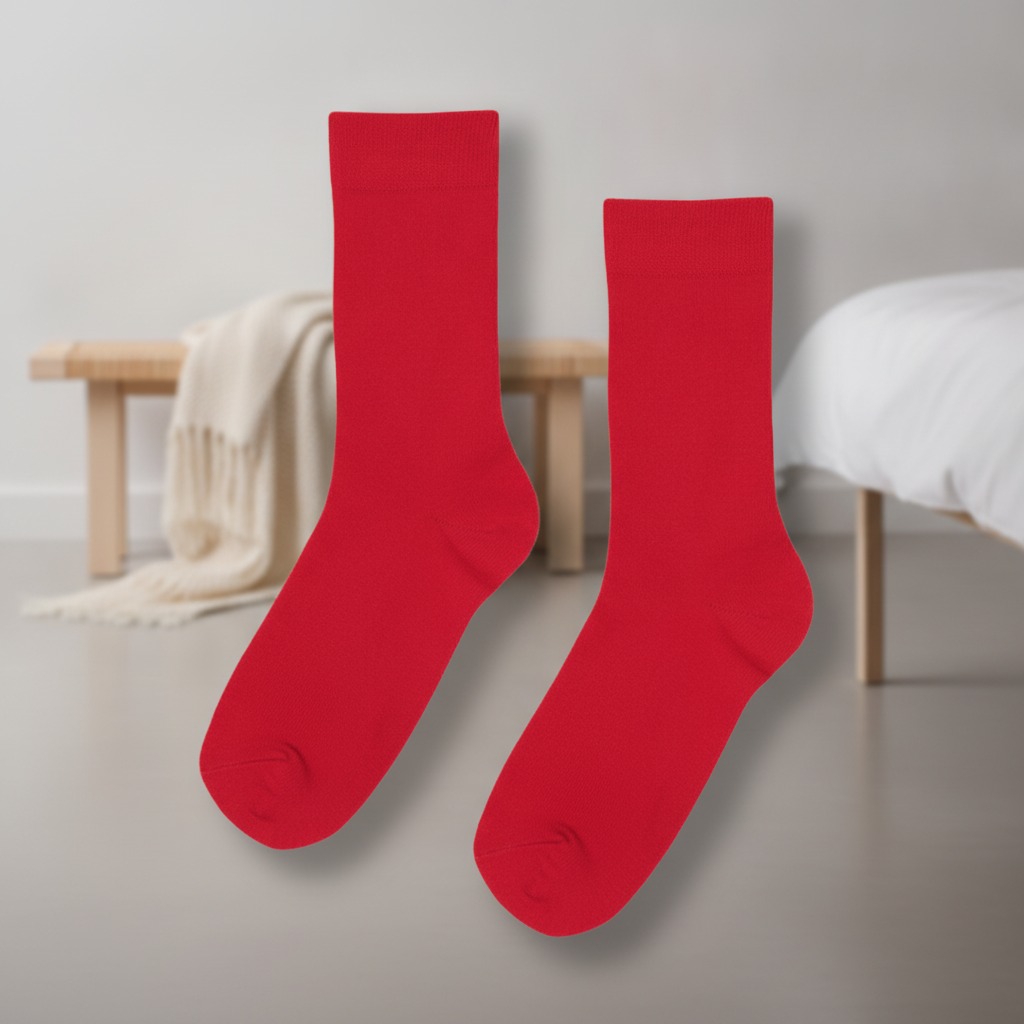
The socks appear to sit at mid-calf rather than stopping at the ankle. That crew-length shape is a familiar choice for everyday footwear because it adds coverage above the shoe line and works well with sneakers, casual shoes, and many uniform requirements.
Plain red knit appearance
The surface looks matte, even, and free from visible patterns or contrast trim. The color is a bright red, which gives the pair a strong visual identity while still remaining easy to build into a larger apparel lineup.
Matching pair construction
The product is shown as a pair of socks with the same shape and finish. For bulk buyers, that matters more than it sounds; matching construction helps keep size, color, and presentation consistent across orders.
Key Specifications and Practical Capabilities
Only the visible product features can be confirmed, so it is best to describe the item in practical terms rather than claim hidden performance. The socks show a straight tubular cuff, a standard heel curve, and a rounded closed toe. That combination suggests a classic everyday build designed to sit naturally inside footwear.
Visible capabilities include simple wearability, color consistency, and broad styling flexibility. The design is suited to daily use where the main expectation is comfort and basic coverage rather than specialty functions. No visible pattern, logo, or decorative panel interrupts the knit, which makes the socks useful for programs that need a neutral base item with a bold color option.
For buyers sourcing a sock for men or a sock for women, the appearance suggests a general-purpose product rather than a gender-specific fashion design. The same style can often be used across different audience groups when the desired look is straightforward and the size range is handled separately.
Materials and Finish Options
The exact fiber blend is not visible in the image, so it should not be assumed. What can be observed is the knit texture and the even, solid finish. In hosiery production, this kind of surface is typically created through knit sock manufacturing, then shaped and finished to form the cuff, heel, and toe.
From a buyer’s perspective, the finish here reads as clean and matte rather than glossy. That usually works well for uniforms, schoolwear, promotional apparel, or retail basics because it looks orderly under natural light and does not compete with the rest of the outfit.
Depending on a manufacturer’s available options, similar crew socks may be produced in different yarn compositions, thicknesses, or surface finishes. Since those details are not visible here, a purchaser should confirm fiber content, stretch feel, and toe seam structure during sampling if those factors affect the end use.
Manufacturing Process
The most likely production route is standard circular knitting or a similar hosiery method. In that process, yarn is formed into a tubular body, then the heel and toe areas are shaped, and the open toe is closed during finishing. The result is a familiar sock structure that balances flexibility and repeatability.
This type of build is well suited to repeat orders because the process can keep color, size, and shape stable when the yarn and settings are controlled carefully. For plain products like this, the quality of the knitting lines, edge finish, and color uniformity tends to matter more than ornamentation.
If a brand plans to order a sock for men or a sock for women in a custom color program, the production workflow usually becomes even more important. Matching dye lots, maintaining cuff elasticity, and keeping both socks in a pair visually aligned are all part of a clean manufacturing result.
Application Scenarios
Everyday wear
The most obvious use is daily footwear. A simple crew sock in a bold solid color works with sneakers, casual shoes, and standard wardrobe basics. It offers coverage without adding visual clutter.
School and work uniforms
Uniform programs often prefer plain socks because they simplify dress codes and purchasing. The red color may be useful when a school, club, or company wants a distinctive palette or needs socks that coordinate with branded apparel.
Bulk apparel and promotional programs
For promotional merchandise, a pair of socks is practical, low-friction, and easy to distribute. The clean face of the knit provides a clear base for packaging or pairing with other apparel items. Since this version is plain, it can also sit comfortably in a multi-item kit where visual consistency matters.
Color-coordinated outfits
Stylists and retail buyers sometimes need one strong accent color to complete a look. A red crew sock can serve that role without relying on graphics or novelty details.
Quality Control Considerations
Even for a simple sock, quality control is worth examining closely. Buyers should look for pair-to-pair color consistency, smooth knitting, balanced toe closure, and cuffs that appear even rather than twisted or stretched out. The image suggests a tidy finish, but procurement decisions should still include sample checks.
Useful inspection points include symmetry between the left and right sock, a consistent heel shape, and the absence of visible defects such as skipped stitches, loose yarn ends, or uneven dye distribution. Because the product is solid red, any color irregularity would be easier to notice than on a patterned sock, which can actually help with visual QC.
For larger orders, it is also sensible to confirm size labeling, packaging method, and carton count before production is approved. Those details are not visible here, yet they often determine whether a bulk program feels organized at receiving and distribution stages.
Customization Guidance for Buyers
If you are sourcing this style for a private label, uniform system, or promotional campaign, start by defining the basics: intended wearer group, size range, desired sock height, and color standard. A sock for men and a sock for women may share the same visual design while differing in size grading or fit targets.
Next, decide whether the plain red surface should stay completely minimal or be adapted with a woven logo, package insert, or label. Since the visible sample has no decoration, it gives a clean starting point for many branding directions. Buyers should also ask about material options, cuff elasticity, and seam construction if comfort requirements are specific.
If the socks are meant for workwear or school distribution, consistency may matter more than fashion detail. If they are intended for retail, the conversation may shift toward texture, stretch, and how the color appears in mixed merchandising displays.
Buyer Decision Factors
When comparing this product with other crew socks, focus on the factors that affect real use rather than appearance alone. The most important questions are: Does the crew height suit the shoe type? Is the color stable and easy to match? Does the construction look neat enough for your program? Can the supplier keep the same look across repeated orders?
Since the image does not reveal fiber content or cushioning, those must be verified if they are critical to your application. For example, a retail buyer may want a softer hand feel, while a uniform buyer may prioritize basic durability and a tidy fit. A clear specification sheet helps avoid confusion later.
It also helps to think about the destination use. A sock for men in a workwear bundle may need a different size spread than a sock for women in a fashion accessory set, even if the visual design stays the same. Matching the product to the end user is usually more efficient than changing the style after launch.
Why This Style Works Well in B2B Purchasing
Plain crew socks are easy to plan, easy to stock, and easy to distribute. That makes them attractive in B2B programs where the buyer needs reliable basics rather than experimental features. The red color creates clear shelf presence or program identity, while the lack of prints keeps the product versatile.
This pair also avoids the complications that come with more technical or decorative hosiery. There are no hidden claims to validate from the image, no visible layering systems, and no fashion embellishments to manage. What remains is a straightforward textile item with broad commercial usefulness.
Request a Quote or Sample
If you are building a uniform package, retail basic line, or promotional apparel set, this crew-length sock is a practical starting point. Share your target size, quantity, color requirement, and packaging preference, then request a sample or quotation based on your program needs. That gives you the fastest route to confirming fit, finish, and consistency before placing a larger order.
评价
Clear filters目前还没有评价