
Lithium Battery Enclosure for Industrial Power Systems
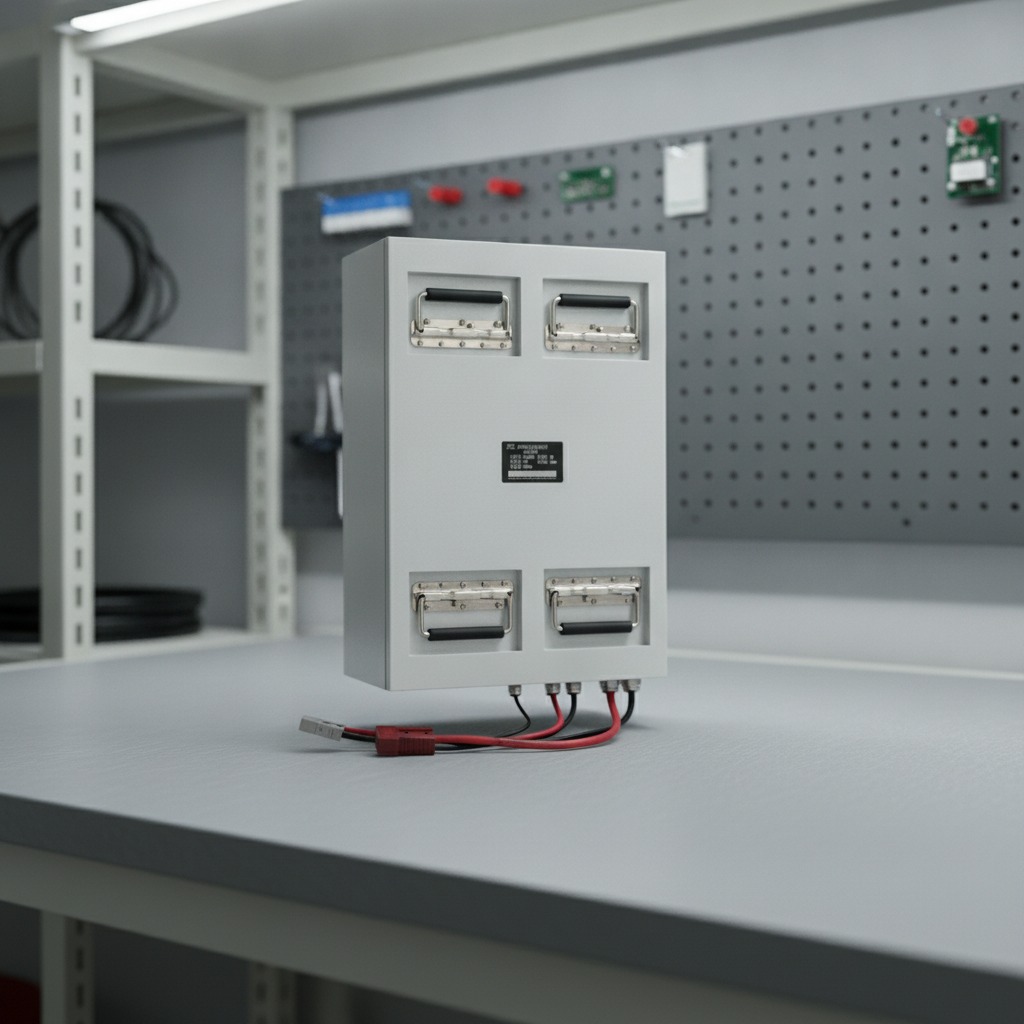
A lithium battery enclosure used in industrial equipment has one main job: keep power components organized, protected, and easy to service while supporting safe cable routing and modular installation. In many plant rooms, energy storage racks, control systems, and power distribution setups, buyers need more than cells alone. They need a sturdy cabinet-style housing that can accommodate internal electrical assemblies, provide external connection points, and simplify maintenance. The enclosure shown here fits that practical need with a white painted metal body, recessed access sections, and bottom cable exits for heavy-gauge wiring.
Product Overview
This unit appears to be a sheet-metal enclosure or battery pack-style cabinet designed for industrial electrical use. The front face is flat and rectangular, with four recessed access sections arranged in a 2×2 layout. Each section includes a metal carry or locking handle with black grip pads, suggesting service access or module handling. A centered identification label is visible on the front, which is typical for equipment traceability and model recognition.
Multiple cable glands or connector ports are visible along the bottom edge, with red heavy-gauge cables exiting the enclosure. That detail points to a design intended for external wiring, power interconnection, or system integration. Because the internal build is not visible, it is safest to describe this product as an industrial enclosure or cabinet that may be used for lithium-ion battery integration, power distribution, or control electronics rather than claiming a specific internal chemistry or system architecture.
What Problem This Type of Enclosure Solves
Industrial buyers often face the same set of issues: exposed wiring, difficult maintenance access, limited space, and inconsistent mechanical protection around power modules. A well-designed lithium-ion battery enclosure helps address those issues by:
- Organizing internal modules into a compact housing
- Protecting electrical parts from accidental contact and handling damage
- Creating clear cable exit paths for safer installation
- Allowing easier inspection and replacement through access points
- Supporting modular equipment layouts in industrial environments
For system integrators, that means fewer installation complications. For maintenance teams, it means quicker access to the cabinet interior and cleaner cable management. For OEM buyers, it means a format that can be adapted into a larger power system or control package.
Visible Design Features
Recessed front access sections
The front panel shows four recessed areas, which likely help protect handles from impact and create a more service-friendly surface. This type of layout is useful when equipment needs to be opened, moved, or secured during maintenance.
Handle assemblies with grip pads
The handle hardware includes black grip pads. While the exact locking mechanism cannot be confirmed from the image alone, the hardware appears intended for repeated manual handling. That is relevant for battery pack-style cabinets or serviceable power modules that may need to be removed or positioned during assembly.
Bottom cable outlets
The lower edge includes multiple connector points and visible red cables. This is a practical feature for any lithium battery system or electrical cabinet because it allows power leads to exit in a controlled direction rather than being pinched or routed haphazardly.
Powder-coated or painted metal finish
The enclosure appears to have a smooth matte or satin white coating. In industrial products, that finish is commonly chosen for a clean appearance and basic surface protection. Exact coating chemistry is not visible, so it should be described as a white painted or powder-coated metal finish.
Likely Materials and Finish Options
Based on the visible construction, the enclosure is most likely fabricated from sheet metal. That is a common choice for industrial battery and control housings because it offers structural rigidity, manufacturability, and straightforward panel forming.
Possible material and finish options for this category of product may include:
- Cold-rolled steel for strong structural enclosures
- Stainless steel where corrosion resistance is a priority
- Aluminum for lighter-weight cabinet designs
- Powder coating in white, gray, black, or custom colors
- Painted finishes for indoor industrial applications
The visible unit appears to use a white finish, which is often selected for clean equipment rooms, technical installations, and modular energy systems where labeling and inspection matter.
Manufacturing Process
An industrial enclosure like this is typically made through a standard sheet-metal workflow. While the exact factory process is not provided, the visible geometry suggests several common steps:
- Sheet cutting by laser, punching, or shearing
- Forming and bending to create the cabinet shell
- Stamping or cutting recesses for handles and access areas
- Welding, riveting, or fastening of internal support features
- Installation of hardware such as handles, glands, and labels
- Surface finishing with paint or powder coat
- Assembly and inspection before shipment
This workflow is important because it affects fit, serviceability, and consistency from unit to unit. For a lithium battery application, precise enclosure fabrication also helps with cable routing and modular integration.
Application Scenarios
This type of cabinet can support several industrial use cases, depending on internal configuration:
Industrial energy storage
A lithium battery enclosure may be used in energy storage systems where modules are housed inside a metal cabinet and connected to external power circuits.
Electrical distribution
The visible cable exits make the design suitable for power distribution tasks, where clean cable entry and exit are needed.
Equipment control
In automation or machinery environments, a similar enclosure can house control electronics, switches, protection components, or communication hardware.
Modular power integration
System builders often need housings that can be stacked, wired, or mounted as part of a larger assembly. A cabinet with accessible handles and defined cable ports supports that approach.
Quality Control Considerations
Because the image does not show internal electronics or test data, quality evaluation should focus on observable cabinet factors and the buyer’s own specification review.
Important checks typically include:
- Panel alignment and enclosure squareness
- Consistency of the painted surface
- Handle mounting strength and hardware fit
- Cable gland placement and strain relief
- Label placement for identification and traceability
- Edge finishing to reduce sharp burrs
If the enclosure is intended for lithium-ion battery integration, buyers should also confirm internal insulation layout, cable segregation, grounding provisions, and any required environmental protection level. Those details are not visible here and should be verified directly with the supplier.
Customization Guidance for OEM Buyers
For custom projects, this enclosure style can usually be adapted in several ways. When discussing a lithium battery or Li-ion battery cabinet with a manufacturer, buyers should specify the following:
- Overall cabinet dimensions
- Number and position of access sections
- Handle type, locking method, and service access needs
- Connector count, size, and cable exit direction
- Material choice and finish color
- Internal mounting brackets or busbar supports
- Labeling, nameplate, and wiring identification requirements
If the product will sit in a harsh industrial environment, buyers should also ask about corrosion protection, ventilation strategy, and compatibility with the system’s electrical layout. Since internal structure is not visible, customization should be driven by drawings and application requirements rather than assumptions from appearance alone.
How to Evaluate the Right Product
Choosing the right lithium battery enclosure depends on more than appearance. Buyers should compare several practical factors:
- Will the enclosure support the intended module size and cable routing?
- Is the access layout convenient for maintenance?
- Does the cabinet material match the environment?
- Are the handles and ports positioned for safe handling?
- Can the finish and labeling support long-term industrial use?
A lithium-ion battery project may need a different housing than a general control box, even if the outer form looks similar. That is why drawings, internal layout plans, and interface details matter before production starts.
Request a Custom Lithium Battery Enclosure
If you are developing an industrial power cabinet, battery module housing, or electrical control enclosure, this style offers a practical starting point. Share your required dimensions, cable interface positions, material preferences, and internal mounting needs so the enclosure can be matched to your system architecture.
For OEM and project-based orders, a clear specification package will help the supplier confirm structure, fabrication method, and finish options before manufacturing begins.




评价
Clear filters目前还没有评价