
LED Display for Clear, Programmable Visual Messaging
An led display gives buyers a practical way to replace static posters, printed signs, and hard-to-update notice boards with a screen that can change content quickly. For retail teams, venue managers, transit operators, and event planners, the real value is simple: one display can carry text, graphics, and motion-based messaging without reprinting or remounting physical signage every time the message changes. The product shown here is a rectangular LED display panel with a dense dot-matrix front face and a rigid cabinet structure, making it suitable for applications where visibility, repeat updates, and reliable electronic control matter.
Product Overview
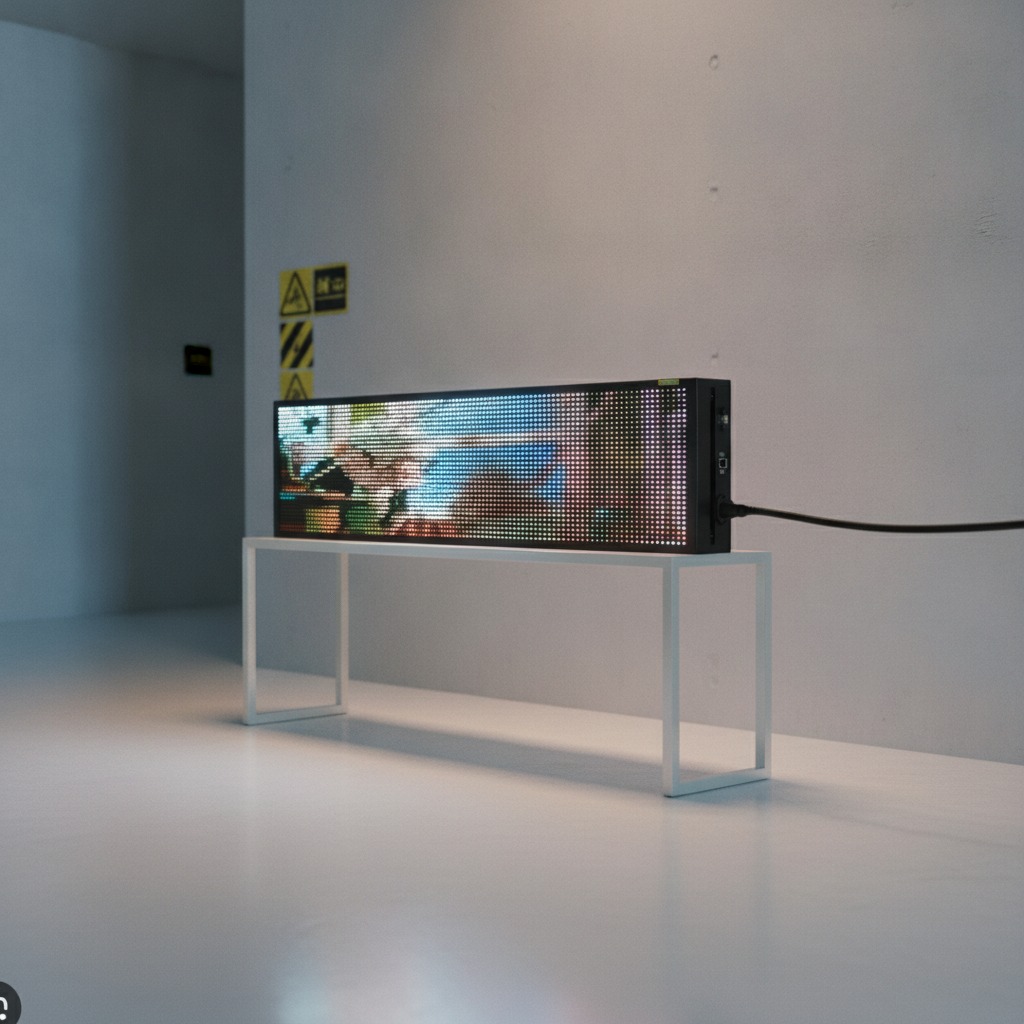
This display appears to be an enclosed LED sign module built around a rectangular cabinet. The front surface shows a grid of illuminated pixel points rather than a continuous LCD-style surface, which suggests it is designed to render characters, symbols, simple graphics, or video-like content through LED modules. The side connection area and cable attachment indicate an electronic system that accepts power and data input, allowing the screen content to be managed remotely or through a controller.
For buyers, this type of screen solves a common operational problem: information changes often, but traditional signage does not. Promotions shift by hour, schedules move, crowd directions need to be updated, and announcement boards must stay readable from a distance. A programmable panel reduces the need for manual sign replacement and helps keep messages current.
Visible Construction and Design Features
The visible enclosure is black and rigid, with a slim rectangular form factor. That cabinet-style build helps protect the internal electronics and gives the unit a clean edge for mounting in an indoor display system or a protected semi-outdoor setup. The face presents a perforated, pixel-like field with evenly spaced points of light, which is typical of a matrix display used for digital signage.
On the side, connectors and mounting points are visible. Those details matter during installation because they affect how the display is linked to power, control hardware, and support structures. The connected cable on the right side confirms that the unit is designed for wired integration rather than being a standalone passive sign.
Key Specifications and Functional Capabilities
Only visible facts can be stated with confidence here, so the following are practical capability cues rather than exact technical ratings:
- Rectangular cabinet format
- Dense LED pixel grid on the front face
- Side-mounted electrical/data connection area
- Enclosed housing for internal electronic components
- Suitable for programmable text and visual content
In use, a display like this is generally selected for message clarity, controllability, and modular installation. Buyers usually match the panel to the viewing distance, content type, and ambient lighting conditions. Since the exact pixel pitch, brightness, refresh rate, and environmental rating are not visible, those points should be confirmed during sourcing.
Materials, Surface Finish, and Cabinet Options
The enclosure appears to be made from a rigid metal or coated metal body with a matte black finish. That kind of finish is often preferred in commercial displays because it reduces glare, looks professional in public spaces, and helps the product blend into walls, kiosks, or control frames. The front module is built around the LED pixel array, while the side frame houses the interface and power connection points.
In manufacturing projects, this style of product is often offered with several enclosure or front-frame options depending on installation needs. Buyers may request different cabinet depths, access styles, or mounting arrangements. When evaluating an LED display ekran, it helps to review not only the screen face but also how the housing will fit into the final structure, especially for built-in signage or wall-mounted systems.
Manufacturing and Assembly Process
Although the exact production method is not visible, a display of this type is typically built through a sequence of electronic assembly steps. LED chips are mounted onto boards, control circuits are integrated, modules are tested, and then the system is fitted into the outer cabinet. In many projects, SMT/PCB-based electronics and cabinet integration are combined so the final unit is both electrically stable and mechanically protected.
The important point for buyers is that this is not just a lighted panel; it is an engineered assembly. Proper soldering, board alignment, connector quality, and cabinet fit all influence long-term performance. A clean internal build also makes future service easier, especially in commercial environments where uptime matters.
Application Scenarios
This type of led display fits a wide range of message-driven environments. It is especially useful where content must be seen quickly and updated frequently.
Retail and Promotions
Stores can use it for sales notices, product highlights, opening-hour updates, or limited-time promotions. The moving or changeable message format can draw attention more effectively than printed signs.
Events and Venues
At exhibitions, arenas, halls, and conference spaces, a programmable screen can show wayfinding, schedules, directions, sponsor messages, or live announcements.
Transportation and Public Information
Stations, terminals, and lobby areas often need fast-changing information. A display with a clear pixel grid can support notice-board style messaging where clarity and update speed are priorities.
Scoreboards and Notice Boards
Sports facilities, training centers, and community venues may use similar panels for scores, timing, and basic event messaging.
Quality Control Considerations
When sourcing a commercial LED panel, quality control should focus on the parts that affect readability and service life. Buyers should ask about module consistency, connector fit, brightness uniformity, and the stability of the cabinet assembly. It is also worth checking whether the screen has been inspected for dead pixels, uneven illumination, loose wiring, and alignment issues before shipment.
Because exact technical values are not provided here, the safest approach is to verify them during sample review or pre-production confirmation. For many buyers, the most important checkpoints are visual consistency across the front face, dependable signal connection, and a housing that remains secure during installation and operation.
Customization Guidance for Buyers
Different projects call for different display configurations. Before ordering, buyers should define several points clearly so the final product fits the real installation environment:
- Viewing distance and audience size
- Indoor, covered, or semi-outdoor placement
- Content type: text, icons, graphics, or video
- Cabinet dimensions and mounting method
- Power and signal access location
- Control method and content update workflow
For a project quoted as LED display fiyat, these details strongly influence final pricing. Screen size, pixel density, cabinet material, control system, and environmental protection usually affect cost more than buyers first expect. A clear specification sheet helps avoid mismatches between budget and actual site requirements.
How to Evaluate the Right Display for Your Project
Start with the viewing environment. If the audience will stand close, the display needs finer detail and sharper readability. If the audience is farther away, a larger cabinet and stronger light output may be more important. Next, consider the message format. Text-heavy applications need stable character clarity, while promotional spaces may prioritize motion and visual impact.
Also think about maintenance. A cabinet with accessible side connections and a well-organized internal build is easier to service. For multi-panel installations, consistency across units becomes essential, especially if the display will be used as part of a larger sign wall or message board.
Why This Format Works in Real-World Use
The rectangular, enclosed format shown here is easy to integrate into commercial spaces because it behaves like a modular building block. It can be mounted, linked, and positioned within a broader signage structure. The dot-matrix LED face gives it a direct, practical visual language: it tells information instead of simply decorating a wall. That is what makes this product useful across many industries.
For buyers who need a display that can support ongoing updates, improve message visibility, and fit into a professional installation, this category offers a straightforward path. It is especially relevant where a static sign would quickly become outdated or where announcements must be changed without delay.
Request a Quote or Technical Confirmation
If you are planning a signage project and need a programmable screen built around a led display structure, the next step is to confirm your required size, mounting style, content format, and operating environment. Share your application details, and request a specification review before ordering. That helps ensure the display matches the installation space and the message you want to present.



评价
Clear filters目前还没有评价