


Battery for 12V Starting and Auxiliary Power Needs
The Xplorer Energy XP31MF battery is a sealed multipurpose lead-acid unit designed to solve a common buyer problem: getting dependable 12V electrical storage and strong starting current in one package. For vehicles, RVs, marine equipment, and auxiliary power systems, the challenge is often balancing cranking power, reserve capacity, and practical installation. This 110Ah, 12V, 770A battery is built for that role, offering a straightforward energy source for starting and general-purpose electrical support.
Product Overview
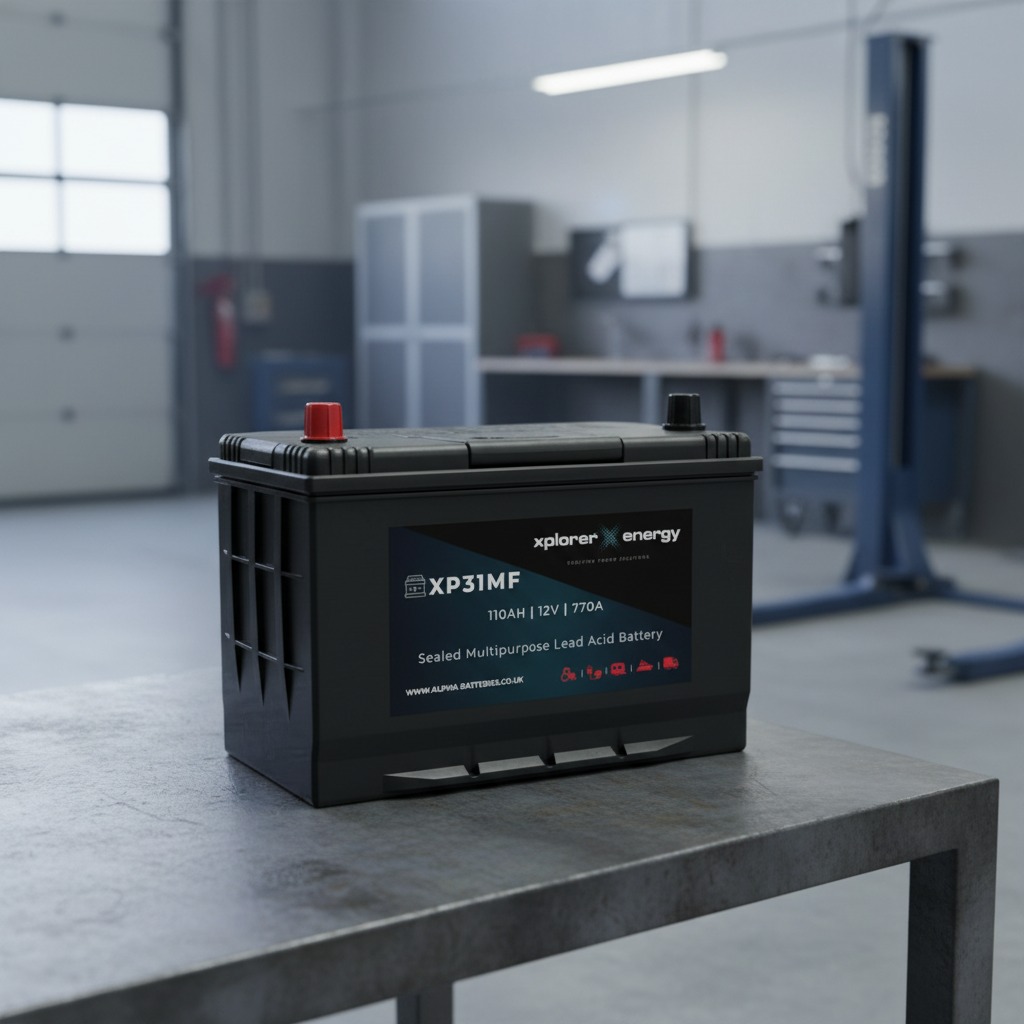
XP31MF is labeled as a 110Ah, 12V battery with a 770A current rating. Based on the visible construction, it is a rectangular sealed lead-acid battery with a rigid black plastic housing, top-mounted terminals, and a form factor commonly used in automotive and auxiliary power applications. The “multipurpose” description suggests it is intended for starting duties and broader 12V power delivery, rather than being limited to a single specialty use.
From a buyer’s point of view, that matters because one battery may need to handle both engine cranking and onboard electrical loads. Lights, control modules, pumps, and accessories can place continuous demand on the system, while startup still requires a short burst of high current. A battery in this class is meant to support both tasks without adding unnecessary complexity.
Key Specifications and Visible Capabilities
Rated Electrical Data
The visible label information identifies three important values: 12V nominal voltage, 110Ah capacity, and 770A current rating. These are the main reference points buyers use when matching a battery to a vehicle or power system. The 12V rating aligns with standard automotive and many auxiliary electrical platforms. The 110Ah figure indicates a substantial storage capacity for general power availability. The 770A rating points to strong short-duration output for starting applications.
Construction Features Seen on the Unit
The case appears to be a matte black, rigid enclosure with molded side ribs for handling and structural stiffness. The top cover is flat, with a centered seam line, and the terminals are positioned on the top surface. One terminal is marked red and one black, which is consistent with positive and negative polarity identification. The geometry is squared and box-like, making it suitable for compact mounting in a battery tray or compartment.
What Is Known and What Should Not Be Assumed
The product can be described safely as a sealed multipurpose lead-acid battery, but the internal subtype is not visible. It should not be assumed to be AGM, gel, flooded, or EFB unless the manufacturer states that clearly. Likewise, exact dimensions, weight, warranty, charging profile, and cycle life are not provided and should be confirmed before purchase. This helps prevent fitment or charging mismatches.
Materials and Finish Options
Only the visible exterior can be described with certainty. The housing is a black plastic shell, likely chosen for impact resistance, electrical insulation, and resistance to everyday handling in vehicle environments. The molded ribs on the sidewalls suggest a design intended to improve grip and rigidity. The top surface has a clean, utilitarian finish rather than a decorative one, which is typical for batteries that must endure vibration, temperature changes, and routine service access.
For buyers comparing battery options, finish and housing design matter more than appearance. A durable enclosure reduces risk during transport and installation, while clearly marked terminals help reduce polarity mistakes. In practical use, the housing should be checked for fit, ventilation needs, and secure retention in the battery compartment.
Manufacturing and Assembly Considerations
This unit belongs to the assembled lead-acid battery category. In general industry terms, such batteries are produced by assembling lead-based electrodes, separators, electrolyte, and a sealed case into a finished electrical storage product. However, the exact plate design or electrolyte system is not stated here, so no hidden construction features should be assumed.
For procurement teams, the important point is to confirm that the battery is intended for the service profile of the application. Starting batteries and auxiliary batteries may be optimized differently depending on repeated cranking, reserve usage, or charging conditions. Matching the battery design to the duty cycle helps avoid premature capacity loss or insufficient cranking performance.
Typical Application Scenarios
Automotive Starting Use
The 770A current rating makes this battery relevant for engine starting tasks, where a high burst of current is needed in a short time. That makes it suitable for vehicles that require dependable cold-start performance or strong ignition support.
RV, Marine, and Leisure Equipment
Because it is described as multipurpose, the battery may also be used for RV and marine auxiliary power, as well as leisure vehicles and similar equipment. In these environments, the battery can support onboard 12V loads while also serving as a backup or starting source. Buyers in these sectors often need a practical balance of capacity and cranking output, especially where space is limited and the system must remain simple.
Backup and Auxiliary 12V Power
Beyond vehicles, the battery can be considered for equipment that needs stable 12V storage and periodic discharge support. This includes auxiliary circuits, service vehicles, and other electrical systems that benefit from a general-purpose lead-acid power source.
Quality Control and Selection Factors
When evaluating a battery like XP31MF, quality control should focus on the visible and documentable points: correct voltage, rated capacity, current output, terminal polarity, and case condition. Buyers should also verify that the battery is undamaged, that the terminals are secure, and that the housing is free of cracks or swelling. For a product used in vibration-prone environments, enclosure integrity is not a minor detail.
The other major decision factor is system compatibility. A battery must fit physically, match the required terminal arrangement, and suit the charging system of the equipment. The current rating and capacity should be aligned with how the battery will be used. If the application is mostly starting, cranking current may be prioritized. If the battery also supports accessories or standby loads, capacity becomes equally important.
Because this product is a lead-acid battery, buyers should also confirm storage and handling expectations with the supplier. Safe transport, correct installation orientation if required, and proper charging practices are all part of long-term reliability. These details are especially important for fleet maintenance and OEM replacement planning.
Customization and Procurement Guidance
If you are sourcing this Battery for a project or replacement program, start with the operating profile. Ask whether the battery will be used primarily for starting, auxiliary power, or both. Then confirm the required 12V compatibility, the needed reserve capacity, and the allowable battery footprint. Terminal layout should be checked before ordering, since even a well-rated battery can be impractical if the connection points do not match the system cabling.
For B2B buyers, customization requests may focus on labeling, packing, documentation, and batch consistency rather than changing the internal battery design. Any request involving chemistry subtype, charging instructions, or life expectancy should be based on supplier-confirmed data, not assumptions. If your procurement process compares this unit with a rechargeable battery or a lithium battery, use the same fitment and duty-cycle criteria so the comparison stays practical rather than theoretical.
Why This Model Fits Many Buyers
XP31MF is a straightforward option for buyers who need a high-capacity 12V lead-acid battery with a strong current rating and a multipurpose use profile. It suits procurement teams that want a familiar battery format, visible polarity markings, and a robust housing. The product’s value is in utility: it supports starting and auxiliary power without requiring a specialized platform.
That practicality is often what matters most. A battery is not just an electrical specification; it is a service component that must fit, connect, and perform in real operating conditions. When the specifications are clear and the application is matched correctly, the result is simpler maintenance and fewer installation surprises.
Request Fitment Support or RFQ
If you need a 12V, 110Ah, 770A sealed multipurpose lead-acid battery for automotive, RV, marine, or auxiliary power use, share your application details, compartment dimensions, and terminal requirements. That information helps confirm fitment and reduce sourcing risk. For procurement and replacement planning, a clear RFQ with application notes is the fastest way to verify whether XP31MF is the right match.




评价
Clear filters目前还没有评价