

Why a simple sock still deserves attention
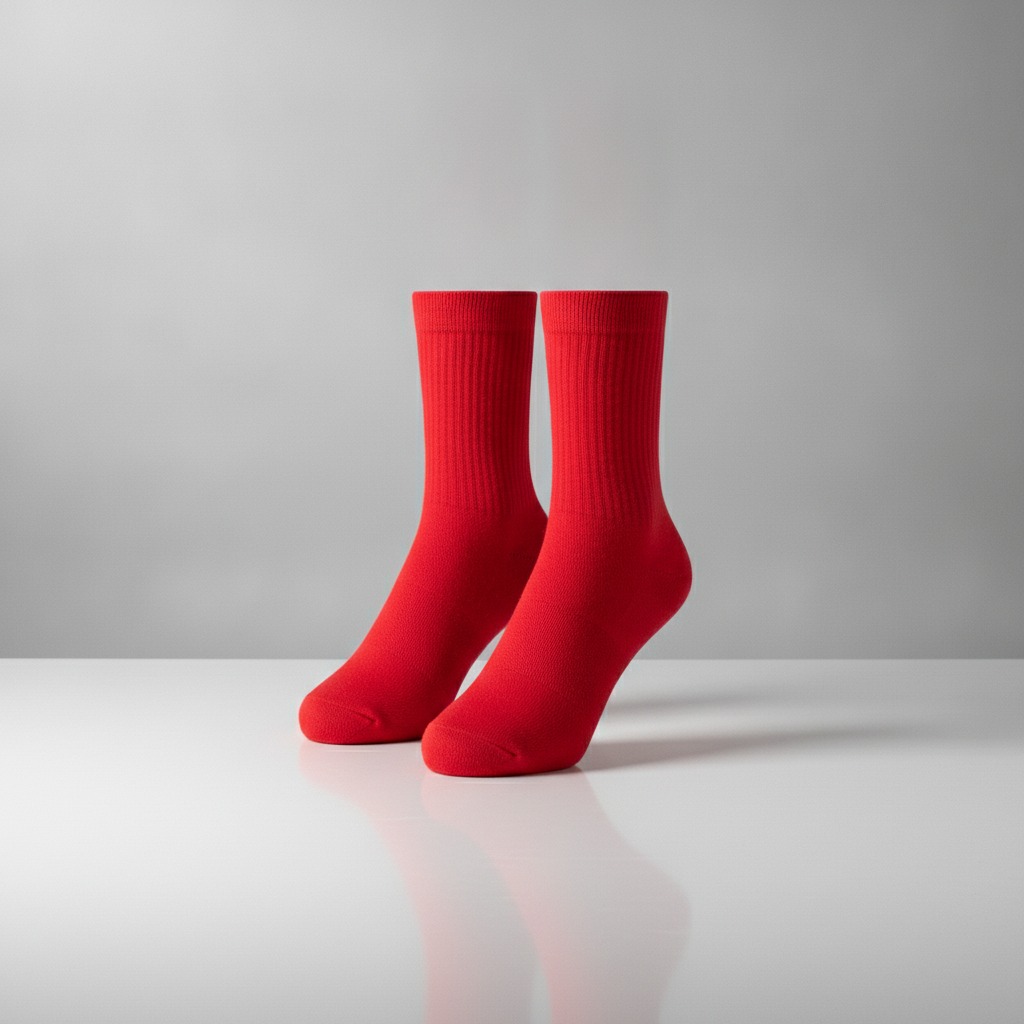
A sock looks uncomplicated until you have to buy them by the hundred, source them for a uniform program, or decide whether a basic retail style will wear well in real life. The pair in front of us is a good reminder: solid red, clean knit fabric, no pattern, no branding, no obvious cushioning, and no visible reinforcement. That kind of simplicity can be an advantage, but it also means the buyer has to know what is being specified and what is not.
For many teams, the decision is not really about style. It is about coverage, comfort, color consistency, and whether the item fits the intended use. A sock for men in a workwear bundle may be judged differently from a sock for women in a retail assortment, yet the manufacturing questions are often the same: What yarn is being used? How is it knitted? Is the toe finished cleanly? Will the color stay consistent from batch to batch? Those questions matter because the visible simplicity of a plain sock can hide a lot of production detail.
What is visible in this product sample
This pair appears to be a crew-length or mid-calf style, sold as a matching set. The socks are flat-lay photographed on a white background, which is common for catalog and sourcing use because it shows shape clearly. The fabric is a uniform solid red, with a smooth surface and no visible logos, stripes, ribbing, cushioning zones, or seam details in the image.
The shape suggests a straight tube cuff, a rounded closed toe, and a slightly contoured ankle and instep area. That tells a buyer something useful even before fiber content is known: this is a basic knitted hosiery item designed for everyday wear, casual use, uniform programs, promotional distribution, or light athletic use. It is not trying to solve a highly technical problem. It is trying to do the basics cleanly.
How socks like this are typically made
At a high level, a sock is usually produced on circular knitting equipment, then finished, shaped, and paired. The exact yarn, gauge, and knit structure are not visible here, so it would be a mistake to pretend otherwise. Still, the general process is familiar to anyone who has sourced hosiery before. The body is knitted into a tube, the heel and toe are formed, and the finishing stage closes the open end and prepares the piece for packing.
In a plain sock with no pattern work, production can look deceptively straightforward. But small choices still affect the final result. Yarn selection influences hand feel and durability. Stitch density influences appearance and breathability. Finishing quality influences whether the sock sits neatly on the foot or twists after a few wears. A buyer who only looks at color and size can miss the issues that show up later in customer complaints or employee feedback.
Why the lack of visible features matters
Because this sample shows no visible cushioning, arch support, compression panel, or reinforced zone, it is best treated as a basic wear item rather than a performance product. That is not a weakness. In many sourcing situations, a simple sock is exactly what is needed. The practical point is that buyers should match the item to the use case instead of assuming a plain-looking product will behave like a technical one.
Where a plain sock fits best
Simple socks have a broad range of applications. They work well in retail apparel, promotional merchandise, basic wardrobe replenishment, and uniform distribution. A uniform manager may want a stable, repeatable red to coordinate with apparel or brand colors. A retailer may want a low-decor item that can be sold as a staple. A buyer building a seasonal giveaway pack may care more about clean presentation and dependable repeatability than about advanced features.
For light athletic wear, a basic sock can still be appropriate if the activity level is modest and the wearer values simplicity over specialty performance. But for long shifts, moisture-heavy conditions, or prolonged standing, it is worth asking for more detail. A sock for men in a warehouse program, for example, may need a different build philosophy than a sock for women in a lifestyle retail line. The size run, leg height, and yarn blend may need to be tuned to the audience rather than selected generically.
Selection criteria buyers should not skip
When evaluating a plain sock, the first thing to confirm is the intended end use. That sounds obvious, but it is where many sourcing problems begin. A budget retail program, a school uniform, and a promotional pack may all call for “basic socks,” yet the acceptable feel, appearance, and wear expectations can be quite different.
Next comes construction. Ask how the pair is knitted, how the toe is finished, and whether the fabric has any areas of reinforcement that are simply not obvious in a flat photo. If the supplier cannot describe the structure clearly, that is worth noting. Good factories usually know how to explain their process in practical terms, even when the garment itself is simple.
Then consider color control. Solid red sounds straightforward until you place several production lots side by side. Small shade shifts are common in textile work, especially if different yarn lots are involved. For branded or uniform orders, that can be enough to create a mismatch. It is sensible to request a physical sample or at least a clear production reference before committing to volume.
Finally, look at size and fit policy. Since this image does not show sizing information, no one should invent it. Buyers should confirm the size range, the intended wearer group, and whether the style is meant to stretch comfortably across a broader fit window or run more narrowly. That is particularly important when stocking mixed-gender programs or order pools that include a sock for men and a sock for women in the same collection.
Common mistakes when sourcing basic hosiery
The most common mistake is assuming that “basic” means “any factory can do it equally well.” In reality, plain knit goods can expose inconsistency faster than complex products because there is nowhere to hide. Uneven tension, sloppy toe finishing, or a weak cuff may be visible immediately once the product is worn or washed.
Another mistake is over-specifying features that do not match the price point or the use case. A buyer may ask for performance language that the product does not actually deliver, which creates confusion later. If the brief is a simple retail staple or promotional sock, keep the specification honest. Clarity beats decoration.
There is also the issue of audience assumptions. A sock for men is not automatically the same thing as a sock for women, especially if the brand expects different fit preferences, color assortments, or merchandising logic. Some programs do not need a gendered distinction at all, but when they do, the distinction should be driven by actual customer needs, not habit.
Practical advice for buyers and product teams
If you are evaluating this kind of sock for sourcing, ask for three things first: a physical sample, a clear material declaration, and a production description that matches the visible product. That may sound modest, but it filters out a surprising amount of ambiguity. The sample should confirm hand feel and finish. The material declaration should tell you what the fabric is made of instead of leaving you to guess from appearance. The production description should explain whether the item is intended for retail, uniform, or promotional use.
For product teams, it helps to think in terms of use environment. Will the wearer be indoors, outdoors, seated, active, or standing for long periods? Will the sock be paired with casual shoes, work shoes, or athletic footwear? Is the main buying trigger comfort, color, price, or standardization? A plain red sock can fit many briefs, but it should not be specified blindly.
If the item will be part of a coordinated collection, consistency matters as much as the individual pair. Matching shade across batches, matching cuff height, and matching overall hand feel can matter more than a minor design flourish that no one will notice on the shelf. That is one of the quiet truths of apparel sourcing: the simplest products often require the most discipline.
FAQ
Is a plain sock always a low-end product?
No. A plain sock can be a deliberate design choice for uniforms, retail basics, or promotional programs. Simplicity does not automatically mean poor quality. It just means the buyer must judge the garment on construction, color consistency, and intended use.
Can one style work for both men and women?
Sometimes, yes, especially in basic or unisex programs. But fit expectations can vary, so it is better to confirm the size range and target audience instead of assuming one spec will satisfy everyone.
What should I ask a supplier when the product looks very simple?
Ask about yarn type, knit structure, finishing method, size range, and color control. Simple products deserve plain answers.
A sensible next step
If you are sourcing this kind of sock, start with the visible facts and build from there. Confirm the use case, request the material and construction details, and compare samples under real lighting rather than relying on a polished product photo. That approach saves time, reduces miscommunication, and makes it easier to decide whether the sock belongs in retail, uniform, or promotional production.
For buyers, the useful question is not whether the sock looks attractive on a white background. It is whether the pair will arrive consistent, fit the intended wearer, and hold up to the environment it is meant for. That is where a simple red sock proves its worth—or exposes its weaknesses.