
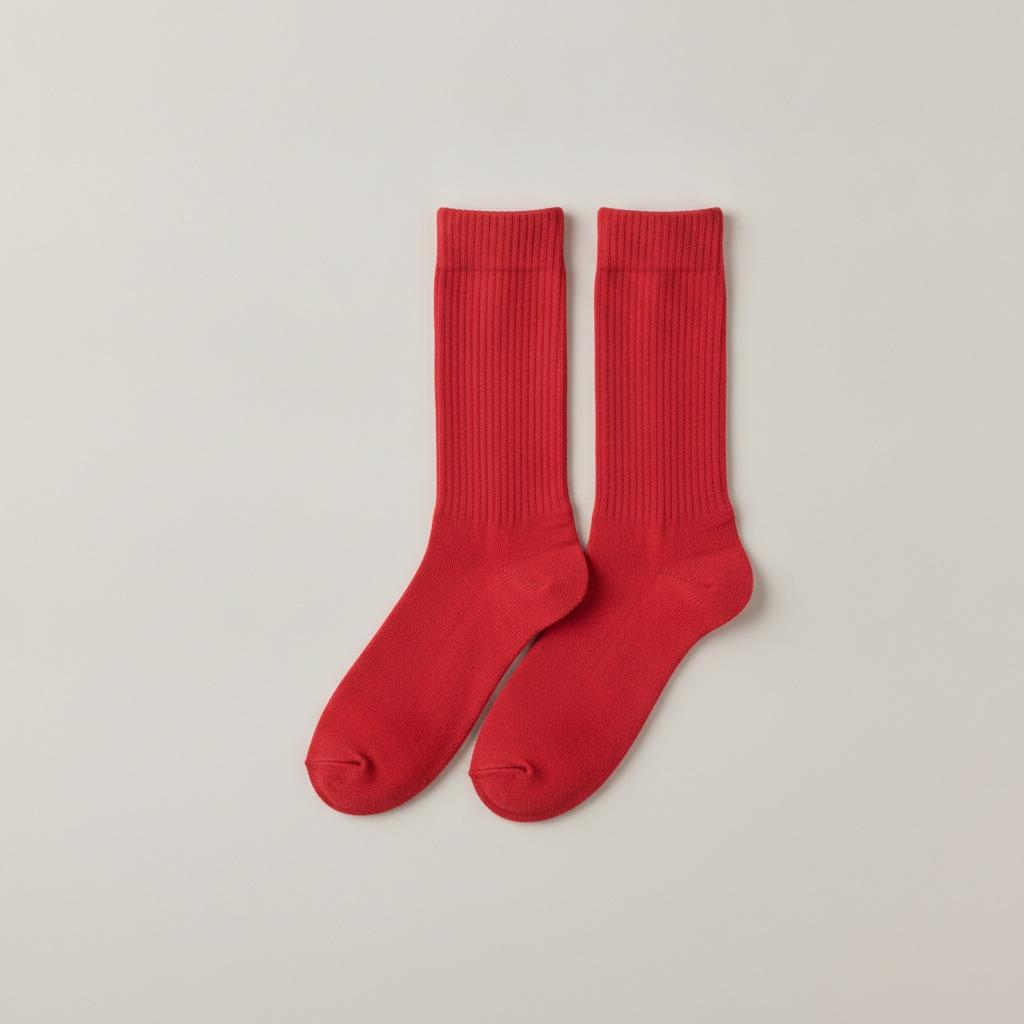
Why a plain sock still deserves attention
A sock looks like the simplest item in a clothing line, but sourcing teams know better. The small details decide whether it disappears into a daily uniform rotation or comes back as a complaint about fit, heat, or early wear. A solid red pair like the one shown here is a useful example because it strips away decoration and puts the focus on construction, yarn choice, and consistency. If you are comparing a sock for men, a sock for women, or a unisex program for retail and promotional use, the real question is not just color. It is whether the item will hold shape, feel comfortable through a full day, and stay stable after repeated washing.
That matters for buyers because the same-looking product can behave very differently once it reaches the foot. One batch may breathe well but sag at the ankle. Another may feel smooth at first and then pill or twist at the heel. A plain sock gives you fewer hiding places, which is actually helpful. Quality is easier to spot when the product is not trying to impress with graphics or heavy cushioning.
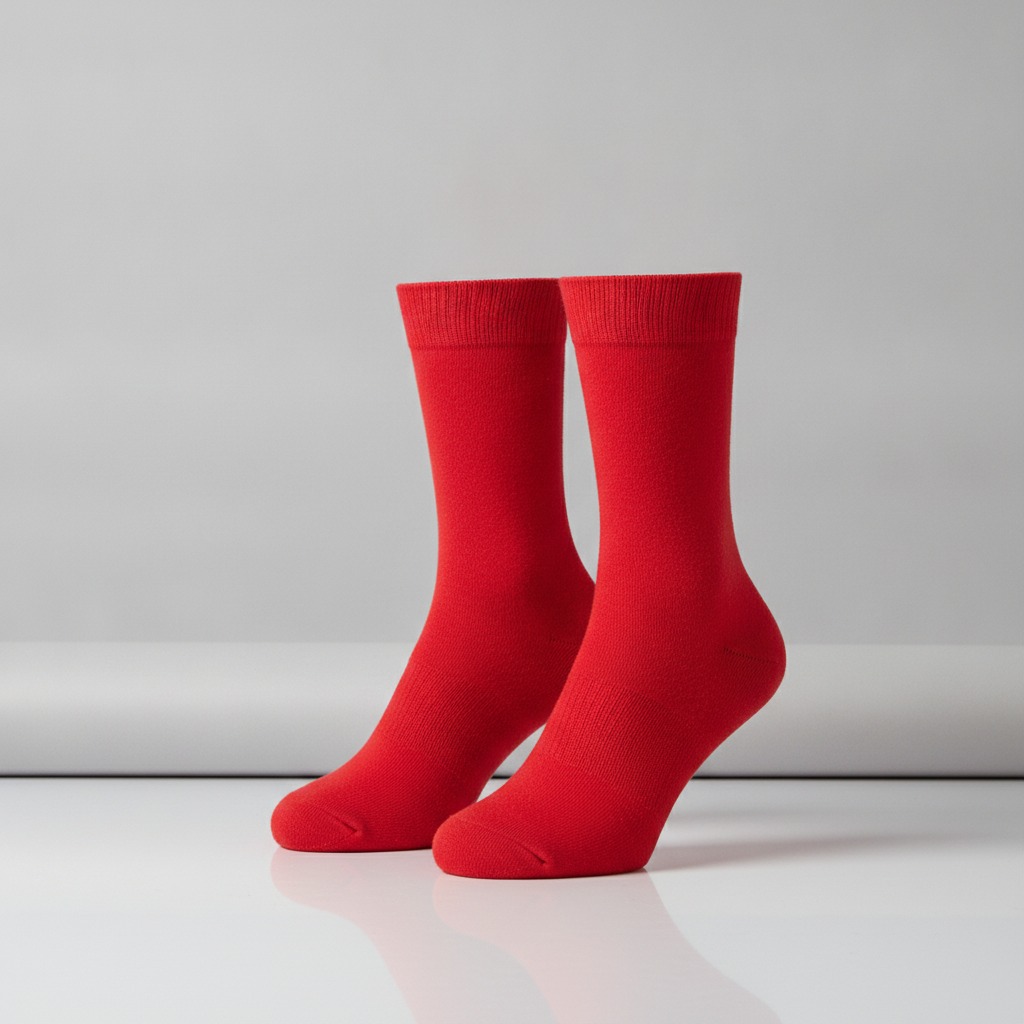
What the visible construction tells a buyer
The pair shown here appears to be an ankle-to-mid-calf knit sock with a tubular shaft, rounded toe, and shaped heel and instep area. That basic profile is common in everyday wear because it balances coverage and ease of movement. The matte, opaque red finish suggests a straightforward solid-dye look, the kind often used for uniforms, retail basics, or private-label assortments where color matching matters more than technical features.
There are also some useful omissions. No logos, no visible ribbing, no decorative bands, and no obvious reinforced zones appear in the image. That does not mean the sock lacks those features in production, only that they are not visible here. For a sourcing conversation, this is a reminder to ask for the sample specifications rather than assuming a product behaves one way because it looks simple. A clean exterior can still hide very different knit structures underneath.
Shape and fit
Toe shape and heel shaping are not minor details. If the toe box is too tight, the fabric can pull across the front of the foot. If the heel is badly placed, the sock may creep down or bunch around the instep. On a product this plain, fit is a major part of the value proposition. The consumer may never describe it in technical terms, but they will notice if the sock stays put or slides around during the day.
Material choices that change day-to-day performance
The fiber content is not visible in the image, so it would be irresponsible to guess a precise blend. In practical terms, though, buyers usually compare stretch knit constructions made from cotton, polyester, nylon, spandex, or blends of those fibers. Each brings a different compromise. Cotton-rich socks often feel familiar and soft, but they can retain moisture longer. Synthetic-rich socks may dry faster and hold color well, but can feel less natural if the hand feel is not balanced carefully. Nylon and elastane, when used in small amounts, usually help with recovery and shape retention.
For a solid red sock, color stability matters almost as much as comfort. Deep shades can show fading, uneven dye uptake, or wash wear more quickly than lighter tones. If the product is intended for a uniform program or a branded retail pack, color consistency between pairs is worth checking early. A bright red sock that looks clean on day one but turns dull after a few cycles will not hold its place on the shelf.
Breathability, cushioning, and compression are also common buyer questions, even when they are not visible from the outside. A lightweight everyday sock usually aims for a balance: enough structure to stay in place, enough porosity to reduce heat buildup, and enough resilience to survive repeated use. A thicker build can feel reassuring in cooler settings, but it may be too warm for office wear or warm-weather retail assortments. There is no single best answer. The right answer depends on the use case.
How manufacturers build a consistent pair
Most sock programs start with knitting, often on circular machinery, though the exact method depends on the design and factory setup. After knitting, the pair is shaped, linked or finished at the toe, then inspected for symmetry and defects. For a simple solid color, the challenge is often not visual complexity but consistency: matching length, tension, elasticity, and color from pair to pair. That is where a plain sock can become surprisingly difficult to execute well.
Factories working on everyday wear usually pay close attention to the heel pocket, toe seam, and cuff behavior. Even when those elements are not visible in a photo, they determine how the sock feels in use. A neat toe finish reduces friction. A stable heel helps the garment track the foot instead of twisting around it. The cuff, if present, should hold without leaving a harsh impression on the leg. Those are small manufacturing choices, but they are exactly the kind of small choices that decide whether a program gets repeated.
Choosing the right sock for retail, uniforms, or promotions
For retail buyers, the main concern is shelf appeal and return rate. A plain red sock works because it is easy to merchandise, easy to understand, and easy to pair with existing wardrobes. For uniform buyers, the priorities change a little. Matching color across lots, maintaining a clean appearance after laundering, and keeping the fit acceptable across a range of foot shapes matter more than trend value. Promotional programs often want a simple, dependable product that can carry a logo or packaging message without fighting the design.
A sock for men and a sock for women do not always need separate constructions, but the fit expectations may differ. Men’s programs often lean toward larger size ranges and slightly broader proportions, while women’s programs may emphasize a narrower fit profile or a lighter hand. In practice, many suppliers now work with unisex bases and size-specific grading rather than making dramatic structural changes. That approach can be efficient, but only if the supplier has tested the fit across the intended audience.
One practical aside: if the end use is a business uniform, do not let color override comfort. An employee who dislikes the fit will find a way around the program, and then the nice-looking sock ends up unused. That is a waste no sourcing manager wants to explain.
What to check before approving a sample
Start with the basics. Check whether the pair matches in length, toe shape, and heel placement. Look for uneven tension, skewed seams, loose fibers, or color variation between left and right. Then move to the hand feel. Is the fabric smooth or scratchy? Does it recover after stretching? Does the cuff grip too hard or too softly?
Washing behavior matters as well, especially for daily wear. Even if the sample feels good in the hand, it should be evaluated after laundering to see whether it shrinks, twists, pills, or loses color. Buyers sometimes skip this step when timelines are tight, and that is where problems hide. A sock that looks polished on the sample table can behave very differently after a few household cycles.
If you are ordering at scale, ask for clarity on fiber composition, knit density, sizing, and finishing method. Those details affect both performance and repeatability. For a simple red program, they also affect whether you can reorder without chasing a different shade or a slightly altered shape.
Common mistakes that lead to returns
The first mistake is assuming that a plain sock is automatically a low-risk item. It is not. Lack of decoration does not remove the need for technical control. The second mistake is choosing a fabric blend only because it is economical, then discovering that it does not meet the moisture or durability expectations of the intended user. The third is ignoring size grading and fit testing, especially when the program is meant for a mixed audience.
Another frequent issue is overpromising on function. A basic sock can be excellent for daily wear, but it may not be the right choice for heavy sports use, compression needs, or specialized work environments. Buyers sometimes try to make one item do too much. That usually creates a product that is mediocre everywhere instead of reliable in one place.
FAQ
Is a plain red sock suitable for branding?
Yes, often. A solid red surface is a clean backdrop for packaging, uniform matching, or private-label identity. It is also less distracting for consumers who want a straightforward basic.
Can the same construction work for different audiences?
Often it can, provided the size range and fit profile are carefully planned. A sock for men and a sock for women may share the same base design, but the grading and comfort expectations should be reviewed before production.
What should matter more: material or construction?
Both matter. A good yarn blend will not save a poor heel shape, and an excellent knit structure will not fully compensate for a weak fiber choice. Buyers should look at the full package.
Next step for buyers
If you are sourcing a sock program, start by defining the end use before you talk about color or packaging. Daily wear, uniform supply, lifestyle retail, and promotional use each push the product in a slightly different direction. From there, request sample details on fiber blend, knit type, fit, and finishing. The goal is not to chase the fanciest construction. It is to find a pair that looks simple, wears well, and can be reordered without surprises. That is the quiet advantage of a well-made sock: it does its job without asking for attention.