
What Buyers Really Need From a Baby Stroller
A baby stroller looks simple enough at first glance: a frame, a seat or bassinet, wheels, and a canopy. But for parents, distributors, and product teams, the decision is rarely that neat. The right baby stroller has to do several jobs at once. It should roll smoothly on sidewalks, fold without a fight, hold essentials in the basket underneath, and feel stable enough that nobody flinches when one wheel catches a crack in the pavement. For an infant stroller, the standard is even higher because the smallest passengers cannot hold themselves up or adapt to discomfort the way older toddlers can.
That is why buyers tend to look past the brochure language and focus on the physical details: frame geometry, wheel size, fabric quality, folding mechanism, and how the bassinet or seat unit is mounted. Those details determine whether a newborn stroller feels reassuring in daily use or becomes one more object that looks good in a catalog but frustrates families after a week.
If you are sourcing, comparing, or specifying a stroller platform, the real question is not “Does it have wheels?” It is “Will this design perform well in ordinary life, where curbs, shopping bags, narrow elevators, and tired hands all show up without warning?”
Quick Takeaways for Sourcing and Product Teams
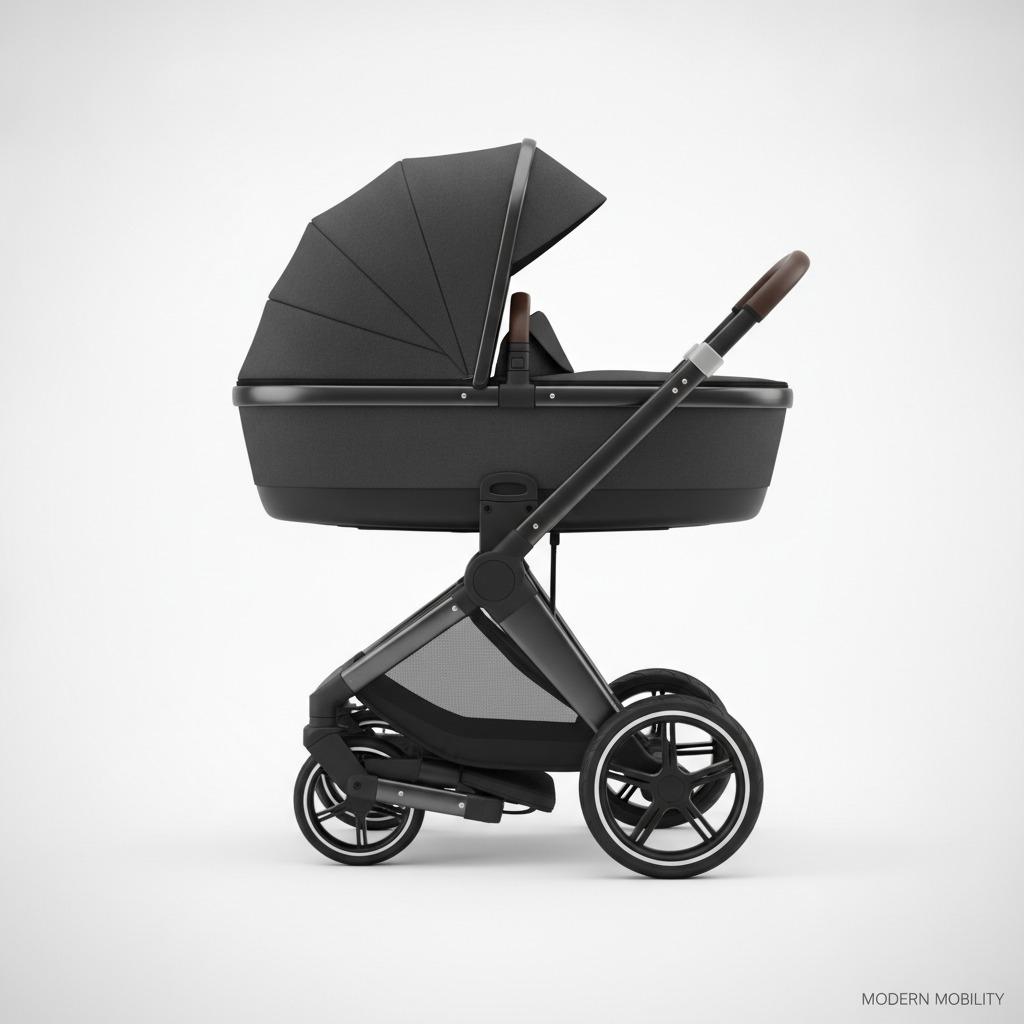
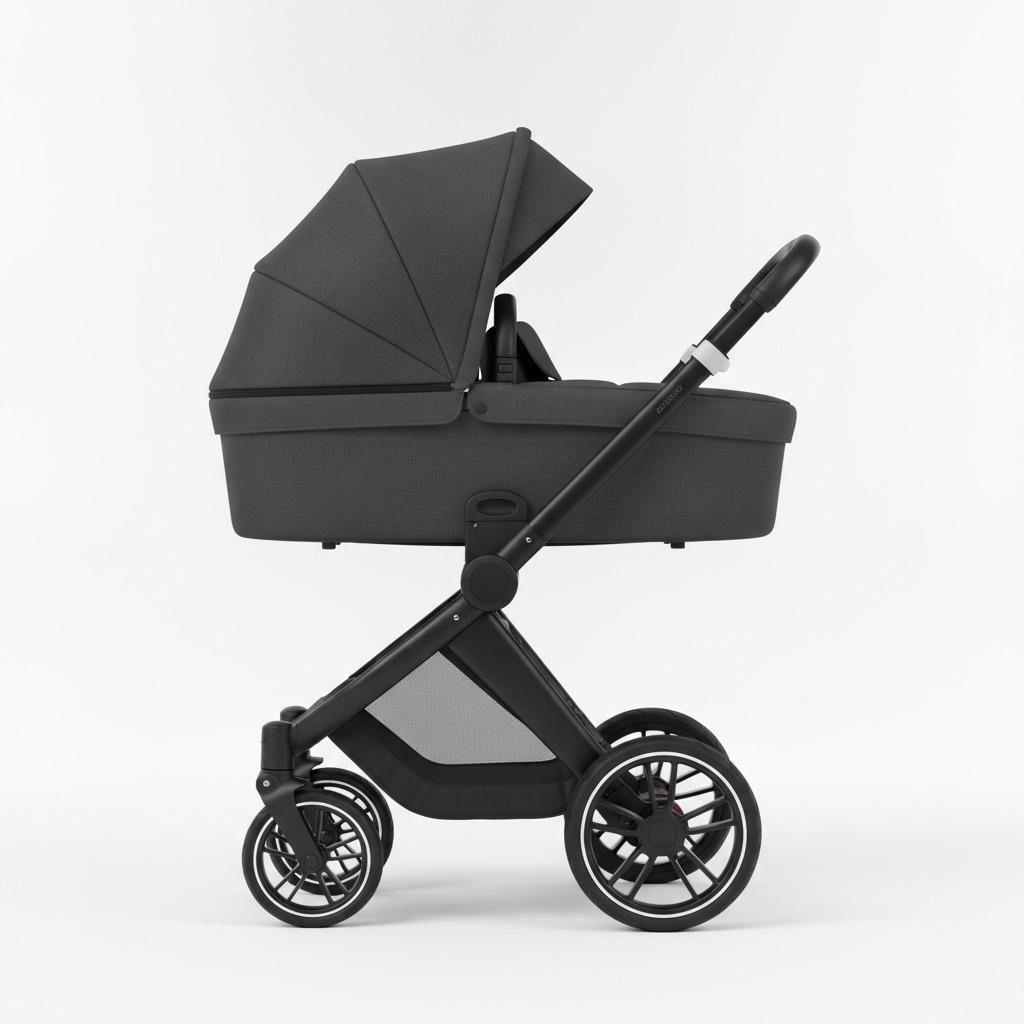
The stroller described here appears to be a modular travel-system style frame with a black textile bassinet or seat unit, a raised canopy, a lower mesh storage basket, and a four-wheel layout with larger rear wheels and smaller front swivel wheels. That combination usually serves everyday transport rather than specialty use. It suggests a product aimed at short walks, errands, and moving baby essentials with reasonable ease.
From a manufacturing standpoint, the visible structure points to familiar consumer-baby-equipment processes: tube forming for the frame, welding or mechanical fastening at the joints, stitched textile fabrication for the body and hood, and injection-molded wheel components. That is standard territory, but the execution matters. A stroller can be built from ordinary parts and still feel premium if the joints are tight, the fabric sits cleanly, and the rolling behavior is balanced. The reverse is also true.
Why the Frame Matters More Than Most Buyers Think
The frame is the quiet backbone of the whole product. In a baby stroller, the frame has to carry the child, the fabric unit, the basket load, and the constant stress of folding, lifting, and rolling. The visible matte black tubular frame in this type of design usually gives a clean, practical look and helps conceal wear better than bright finishes. That matters in real use. Scrapes and scuffs happen quickly on baby gear, especially when it is loaded into car trunks or moved through entryways.
When evaluating a frame, sourcing teams usually care about three things: stiffness, fold behavior, and joint durability. Too much flex makes the stroller feel cheap and unstable. Too little practical give can make folding awkward or create harsh feedback over uneven ground. A good infant stroller frame should feel controlled, not brittle. If the product uses a travel-system approach, the attachment point for the bassinet or seat unit deserves close attention too. That junction is where convenience can either become a selling point or a complaint.
Wheel Layout: Small Detail, Big Difference
Wheel design often separates a stroller that just moves from one that is genuinely pleasant to push. The visible layout here uses larger rear wheels and smaller front swivel wheels. That is a familiar arrangement because it tends to balance steering with stability. The rear wheels help the stroller roll more comfortably over uneven pavement, while the smaller front wheels make the turning radius more manageable in shops and tight hallways.
For buyers, this is one of the most practical parts to inspect. Wheel size, tread feel, mounting quality, and the way the front wheels pivot all affect the experience. A stroller can have attractive upholstery and still feel unpleasant if the front wheels chatter on rough surfaces. Conversely, a slightly more utilitarian wheel package can earn loyalty if it rolls cleanly and does not require constant correction.
One practical caution: wheel performance is often easy to underestimate during early sampling. A short showroom push may not reveal how the stroller behaves after repeated loading, curb drops, or months of use. If the wheel mounts or joints are loose from the start, that usually gets worse, not better.
Bassinet, Seat, or Convertible Unit?
Based on the visible structure, the top unit appears to be a bassinet-style or reclining infant cradle, though the exact configuration is not confirmed. That distinction matters. A true bassinet-style unit is typically aimed at younger babies who need a flatter, more supportive resting position. A reclining seat unit can extend usability as the child grows. A convertible system tries to serve both needs, which is attractive in the market but often depends on how well the changeover is engineered.
For the buyer, the key issue is not just how the unit looks in one position. It is how the transformation feels: does the canopy move smoothly, does the textile stay taut, and do the attachment points inspire confidence? If the upper unit wobbles, shifts during use, or requires awkward handling, the stroller will seem less premium even if the materials are fine.
What to check during sampling
Look at the connection between the upper unit and the frame. Check the fabric tension around the sides and head area. Examine whether the canopy holds its shape or collapses loosely. Small problems here are the ones parents notice immediately, because they affect everyday handling and the sense of security around the baby.
Storage Basket and Daily Usability
The lower storage basket is one of those features that sounds secondary until a parent starts using the stroller every day. Mesh-sided baskets are common because they keep weight down and allow visibility, but the tradeoff is that they can snag, sag, or collect dirt if the stitching and edge binding are not well executed. In the stroller shown, the basket appears practical rather than decorative, which is usually the right choice. Parents need a place for diapers, wipes, a bottle, a jacket, and the kind of random items that appear whenever a baby leaves the house.
For a sourcing manager, basket construction deserves attention because it often reveals the maker’s discipline. Clean seams, even tension, and durable attachment points suggest the factory understands real-world use. Sloppy basket work is often a warning sign for the rest of the product.
Materials and Manufacturing: What Can Be Said Safely
The visible finish suggests a matte black coated metal frame, likely aluminum or steel tubing, though that cannot be confirmed from appearance alone. The textile body and canopy appear to use dark woven fabric, while the wheels look like plastic or rubber components with molded spoke detailing. This is a common and sensible material mix for a consumer stroller because it balances cost, weight, and appearance.
In manufacturing terms, the frame would generally involve tube forming, joining, and finishing. The textile parts would be cut, stitched, and assembled around the seat or bassinet structure. Wheels and smaller connectors are often injection molded. None of that is unusual, but the way these parts are combined separates a dependable product from an average one. Alignment must be consistent. Fold points must not pinch or distort the fabric excessively. And the stroller should still look composed after assembly, not like a collection of parts forced into the same job.
How to Choose the Right Infant Stroller for Your Market
If you are comparing options for retail, private label, or product development, start with the user scenario. A stroller meant for apartment living and quick errands will have different priorities than one intended for rougher streets or more frequent travel. The same baby stroller architecture may work for both, but the design emphasis should change.
Here are the practical selection points worth weighing:
First, assess the folding behavior. Buyers care about whether the frame folds compactly and whether one person can manage it without wrestling the canopy and basket at the same time. Second, study wheel behavior. A stroller that rolls well on uneven ground can broaden its appeal fast. Third, examine the top unit. Whether it is a bassinet, a reclining seat, or a convertible module, it should feel secure and easy to operate. Fourth, look at the textile quality. Fabric that looks neat on day one but wrinkles, sags, or stains badly will damage the product’s perceived value. Finally, consider the basket and handlebar ergonomics, because those are the points that meet the parent’s daily routine.
Common Buyer Mistakes
One common mistake is choosing a stroller mainly from photos. A polished image can hide a stiff fold, rattling wheel mounts, or a canopy that is more decorative than functional. Another mistake is overvaluing accessories while underestimating structure. A cup holder or fancy trim will not compensate for a frame that feels unstable.
Another easy trap is assuming all infant stroller models are interchangeable because they share a similar silhouette. They are not. Small differences in frame width, wheel spacing, and upper-unit geometry can have a real effect on handling and storage. If the stroller is intended for export or private-label retail, those differences also influence packaging, shipping efficiency, and customer complaints. It is usually better to spend time on structure and usability than to chase a surface-level feature list.
FAQ for Buyers
Is this style suitable for newborn use?
It appears to be designed for early-life baby transport, likely with a bassinet or reclining upper unit, but the exact age range is not confirmed here. Buyers should verify the intended configuration before assuming newborn suitability.
Does the larger rear wheel layout matter?
Yes. In many stroller designs, larger rear wheels improve rolling over uneven surfaces and help the stroller feel more planted. That does not automatically make it better in every environment, but it is a useful advantage for everyday walking.
What should be checked first in sample testing?
Start with the fold, the wheel motion, the frame lock points, and the upper-unit attachment. Those areas reveal most of the practical quality issues very quickly.
What a Good Next Step Looks Like
If you are evaluating a baby stroller for sourcing or product planning, treat the sample as a working mechanism, not just a finished consumer object. Push it over rough ground. Fold it with one hand if possible. Check how the basket hangs when loaded. Look closely at the stitching, the joint alignment, and the way the canopy sits over the baby space. Those are the details that separate a stroller families trust from one they simply tolerate.
If you are building a brief for suppliers, ask for clear confirmation on materials, frame construction, wheel assembly, folding method, and the exact configuration of the top unit. That will save time later, and in baby products, time saved early often means fewer headaches after launch.
For teams comparing infant stroller concepts, the best choice is usually the one that combines straightforward construction with calm, predictable handling. The market does not need another complicated stroller. It needs one that rolls smoothly, folds sensibly, and makes an ordinary day with a baby feel a little less difficult.