
Why the right decking importer matters before you place a container order
Buying from a decking importer is not just a matter of finding boards that look good in a photo. For engineers, sourcing managers, and product teams, the real question is whether the boards will arrive with consistent profiles, install cleanly, and hold up in the kind of outdoor use the project actually demands. That is especially true for interlocking decking/plank boards, where the surface finish, edge geometry, and internal structure all affect how the finished deck behaves in service.
Anyone who has handled a mixed shipment of outdoor boards knows the problem. One batch locks tightly and lays flat. The next batch carries a slightly different profile, and suddenly installers are trimming, shimming, or forcing boards into place. A competent decking supplier can reduce that risk. A weaker one may still offer a low price, but the hidden cost shows up on site, where labor is more expensive than the material.
This article is aimed at buyers trying to decide what to ask, what to inspect, and where a decking distributor adds value versus where they simply move cartons. The goal is practical: help you judge whether a product is suitable for a deck, patio, balcony, poolside area, or other exterior platform before it becomes a field problem.
What the product appears to be
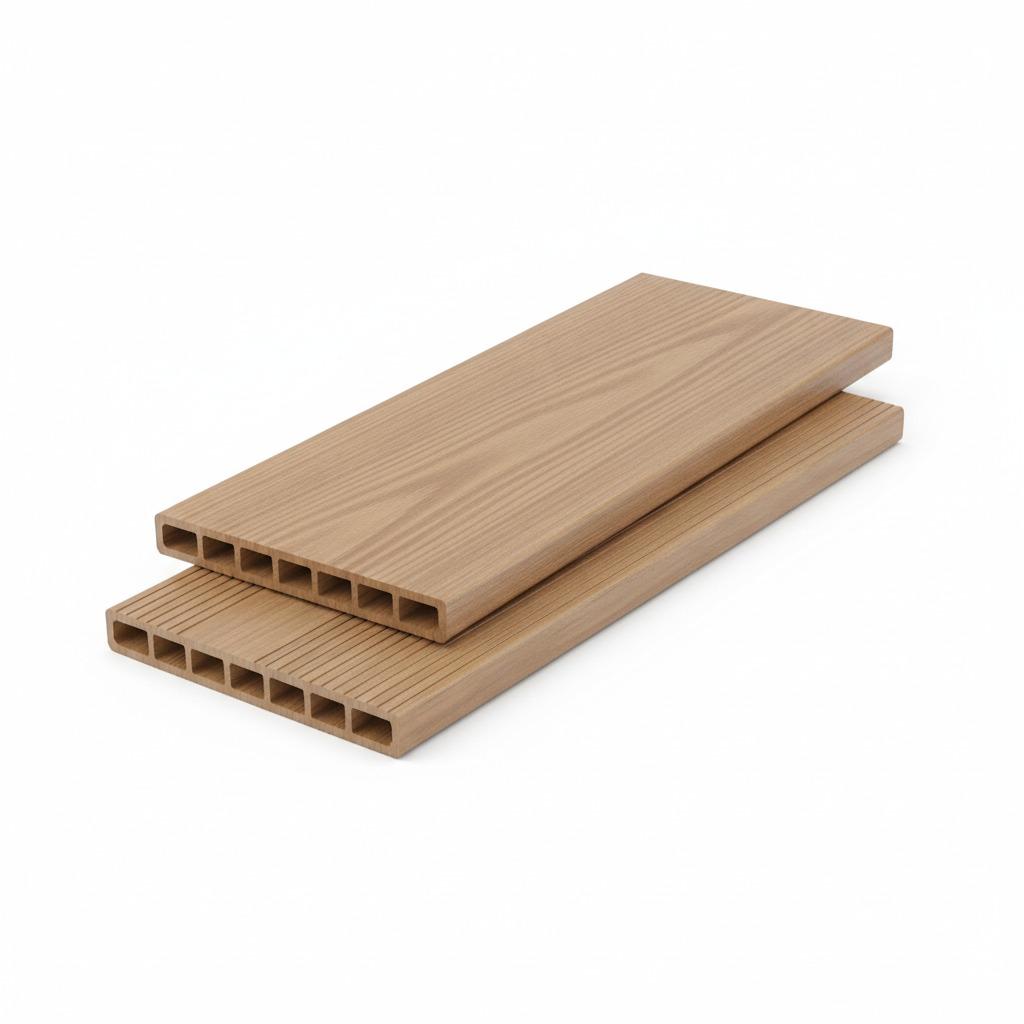
The product in question appears to be an interlocking decking board with a wood-grain or grooved surface, likely intended for outdoor flooring or cladding. Based on the visible cross-section and top faces, it resembles a wood-plastic composite or similar engineered outdoor board. That is a cautious reading, not a lab analysis. Still, the visible features tell a useful story.
The boards are long and flat with uniform thickness, and the profiles appear hollow-core with multiple internal channels. That hollow structure can reduce weight and material use, which often matters in large installations and in transport cost planning. The edges show a side-locking or tongue-and-groove style geometry, suggesting the boards are meant to align neatly and create a more finished walking surface.
Two surface textures are visible: one board has a brown wood-grain finish, while another shows narrow linear grooves. That kind of variation is common in exterior decking systems because different finishes can support different design goals. A grooved surface may help with appearance and water shedding, while a wood-grain face may better match a residential terrace or hospitality project where the design brief is warmer and less industrial.
What buyers usually need to decide first
When a project team starts sourcing, the first temptation is to compare colors. That is usually the wrong starting point. The real decision is whether the board format fits the installation environment and the maintenance expectations.
For example, a residential balcony has different demands from a commercial walkway. A poolside area raises different concerns again, especially around moisture exposure and cleaning cycles. A renovation job adds another layer: the new boards may need to fit existing substructures or transition to older materials. In all of those cases, the importer should be able to explain the board profile clearly and provide enough product information for the contractor to verify compatibility.
Buyers should also ask whether the product is intended for decking only or if it can be used in cladding-style applications as well. Some interlocking profiles are versatile, but not every profile is a good fit for every direction of load or every installation method. A good importer will not oversell the board as universal.
Quick-reference takeaways for sourcing teams
Here is the short version, the kind of note a sourcing manager might keep before a supplier call.
Interlocking boards can simplify installation, but only if the profile consistency is reliable. Hollow-core construction may help with handling and logistics, yet it also means the product design must be appropriate for the application. Surface finish matters, but so do the unseen details: edge fit, board straightness, and how the supplier manages batch consistency.
If you are evaluating a decking distributor, ask how they describe the profile, what documentation they can supply, and whether they can distinguish between surface texture variants. If the answer is vague, the risk is usually not in the brochure; it is in the pallet.
How these boards are typically made
From the visible structure, the boards are likely produced by extrusion, which is a common process for composite decking profiles. In simple terms, the material is shaped continuously through a die, producing a long board with a fixed cross-section. Surface embossing or texturing is then used to create a wood-grain effect or linear grooves.
That process has practical advantages. Extrusion can support consistent profile geometry, which matters for interlocking edges. It also makes it easier to create hollow sections and internal channels that reduce weight. But extrusion is only part of the story. For outdoor boards, the quality of the surface finish, color stability, and dimensional repeatability often matter just as much as the base material.
One caution: buyers sometimes assume that any board with a similar appearance will perform the same. That is not a safe assumption. Two products can look nearly identical in a photo and still behave differently in cutting, fastening, or temperature movement. A decking importer who knows the product well should be able to talk about those differences without hand-waving.
Where the visible design features help in real projects
Hollow-core structure
The hollow-core construction seen in the profile can be useful in reducing weight, which may ease handling during installation and lower freight burden. For large terrace projects or multi-unit residential work, that is not a small matter. Less weight can also make manual positioning less punishing for installers.
Still, hollow does not automatically mean better. The application has to suit the structure. A buyer should consider whether the intended use calls for a lighter board or whether a more substantial profile is needed. A decking supplier should be ready to discuss that trade-off plainly.
Interlocking edge profile
The side-locking or tongue-and-groove style edge profile is one of the more useful visible features. It supports alignment during installation and helps create a continuous surface. In the field, that can save time and reduce the chance of uneven joints.
But interlocking systems also depend on profile consistency. If one batch is slightly off, installers can feel it immediately. This is why many experienced buyers focus less on the marketing language and more on whether the supplier can maintain repeatable dimensions across production runs.
Surface texture
The two visible surface finishes suggest the board may be offered in more than one appearance. That matters because design teams often want a choice between a natural wood-look face and a more technical grooved surface. For commercial settings, a restrained texture may be easier to integrate into an overall architectural palette. For residential jobs, the wood-grain face may do more of the visual work.
Texture is not purely aesthetic, though the image alone does not allow claims about slip resistance. Still, the finish influences cleaning, weathering appearance, and how visible dirt or scuffing becomes over time. In outdoor products, those everyday realities are often more relevant than a polished catalog description.
How to evaluate a decking importer before buying
There is a difference between a trading contact and a serious decking importer. The serious one can explain the board profile, confirm what is known and unknown, and help you avoid installing an unsuitable product into an expensive site.
Start with the basics. Ask for clear product descriptions, profile drawings if available, and images that show both the surface and cross-section. If the importer cannot distinguish between solid and hollow structures, or if they speak vaguely about the material composition, take that as a warning sign. Not because they are necessarily dishonest, but because they may not control the product well enough to support a project sale.
Next, ask about batch consistency and packaging. Outdoor boards are long, and long boards are sensitive to handling. Damage during transit can create complaints that look like quality issues but are really logistics failures. A good decking distributor will understand this and will care about pallet protection, edge damage, and the way boards are stacked.
Finally, ask how the supplier positions the product. Is it aimed at renovation work, residential terraces, commercial projects, or moisture-exposed areas? The answer should be specific. If every use case is presented as equally suitable, that usually means the supplier is still telling the story, not understanding the product.
Common mistakes buyers make with outdoor decking boards
One common mistake is buying only on appearance. The brown wood-grain finish may look right in a sample photo, but if the profile does not suit the installation, the aesthetics will not rescue the job.
Another mistake is assuming all interlocking boards are interchangeable. They are not. Small differences in edge geometry can change installation speed and the quality of the final fit.
A third mistake is underestimating the handling side of the order. Hollow-core boards may be easier to manage, but they can still be damaged if stacked poorly or shipped without proper protection. The cheapest quote can become the most annoying one if every second board needs sorting on arrival.
Practical buyer advice for sourcing discussions
If you are speaking with a decking importer, keep the conversation grounded in use case. Mention the project type, exposure conditions, expected maintenance approach, and whether the boards are for new build or renovation. That gives the supplier a real basis for recommending the right profile.
Then ask for a side-by-side explanation of the available surface finishes. In this product’s case, the grooved board and the wood-grain board may suit different aesthetics or installation preferences. A practical supplier should be able to explain why one would be chosen over the other instead of simply calling both “premium.”
Also, be direct about what you need to verify and what remains unknown. Exact material formulation, dimensions, load rating, weathering data, slip resistance, and fastening system details should not be assumed if they are not supplied. That may sound obvious, but projects slip when assumptions fill the gaps left by incomplete product information.
What a useful next step looks like
For teams evaluating an interlocking decking board, the next step is usually a sample and a real conversation, not a prettier brochure. Ask the decking supplier or decking distributor for a clear product sheet, a cross-section view, and enough detail to compare the profile against your project requirements. If the supplier can speak plainly about what is visible, what is confirmed, and what still needs verification, that is usually a better sign than any sales slogan.
In outdoor materials, small profile details often decide whether a project feels well executed or merely finished. That is why the importer matters. Not as a middleman in the abstract, but as the gatekeeper between a promising-looking board and one that actually works on site.
FAQ
Is this product definitely wood-plastic composite?
It appears consistent with wood-plastic composite or a similar engineered outdoor board, but that cannot be confirmed from appearance alone.
Can these boards be used for decks and cladding?
The visible form suggests outdoor flooring or cladding potential, but suitability depends on the exact profile, substructure, and project requirements.
Why does the hollow-core design matter?
It can reduce weight and material use, which may help with handling and logistics. It does not automatically make the board better for every application.
What should buyers ask a decking supplier first?
Ask for the profile description, surface finish options, and any documentation that clarifies dimensions, structure, and installation method.