
Why wpc decking keeps showing up in outdoor project specs
wpc decking has become a practical answer for buyers who want the look of timber without accepting timber’s maintenance burden. That is the real search intent behind most questions on this topic: not “what is it,” but “is it the right choice for my deck, terrace, balcony, or walkway?” For engineers, sourcing managers, and product teams, the decision usually comes down to a few hard issues—durability, installation behavior, weight, appearance, and the level of upkeep a customer will tolerate after handover.
The boards in this category are often sold as wood plastic composite decking or simply composite decking, and the appeal is easy to understand. You get a wood-grain surface, a more uniform profile than natural lumber, and a material that is generally better suited to repetitive outdoor use. The tradeoff is just as important: composite boards are not all made the same, and a good-looking sample can still be the wrong fit if the internal structure, fastening method, or surface finish does not match the project.
What the product image suggests, and what it does not
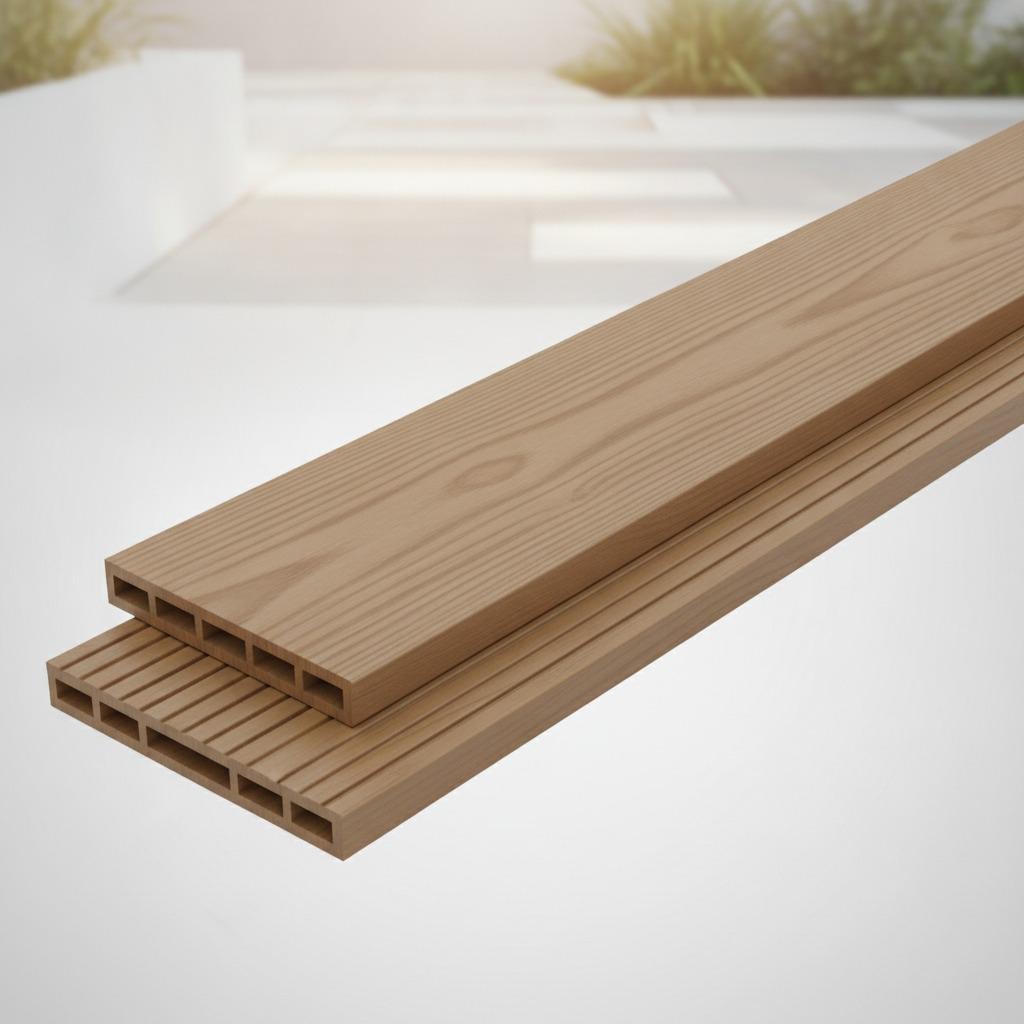
The product shown appears to be a hollow-core composite decking board with a brown wood-look finish and pronounced grain texture. The internal profile looks multi-chambered, which is a common way to reduce weight while keeping enough stiffness for outdoor floor applications. One face appears embossed to mimic timber; the other side looks grooved or ribbed, which may help with traction or drainage depending on how the board is installed.
That said, there is a limit to what can be concluded from appearance alone. The exact formulation is not visible, so it should not be assumed to be a specific grade of wood plastic composite, nor should any exact slip rating, fire performance, UV resistance, or load capacity be inferred without supplier data. For buyers, that caution matters. A board can look premium and still be unsuitable for a pool surround, a roof terrace, or a commercial seating area if its technical backing is thin.
Why buyers choose composite decking over timber
The strongest argument for composite decking is consistency. Natural wood varies from board to board, and that variation can be attractive in some projects but troublesome in others. Composite profiles are extruded to a controlled shape, so the dimensions and appearance are generally more uniform. For project teams trying to standardize a bill of materials across multiple sites, that predictability is valuable.
Maintenance is the second reason. Outdoor timber usually asks for sanding, sealing, staining, or periodic repair, especially in wet or sun-exposed locations. A composite deck board is usually selected to reduce that workload. Buyers should be careful with the word “maintenance-free,” though. That claim is often used loosely. In practice, these products still need cleaning, inspection of fixings, and sensible design details such as drainage and ventilation. Ignore those basics and even a good board will age badly.
There is also the weight factor. Hollow-core boards can be easier to handle on site than solid boards, which may help when labor is limited or when the structure below has a conservative load allowance. That lighter construction is not a free advantage, however. Hollow profiles need proper support spacing and careful edge treatment, or they may feel less rigid under foot than a buyer expects.
Key features worth checking before you buy
1. Surface texture
A wood-grain embossed face can improve visual realism and make the product more acceptable in residential or hospitality settings. But texture is not just cosmetic. Surface pattern affects slip behavior, cleaning effort, and how quickly dirt becomes visible. A deep grain may look attractive in a showroom and then hold dust on an exposed roof terrace. That is a practical annoyance, not a theory.
2. Hollow structure
Hollow-core boards are common in this category because they reduce material use and shipping weight. For many applications, that is a sensible compromise. The buyer’s job is to confirm whether the board is being installed on a patio, balcony, garden path, or commercial deck where impact loads or concentrated foot traffic are a concern. A hollow board can be perfectly suitable, but only if the supporting frame and span design are matched to it.
3. Edge profile and installation method
The visible edges suggest an interlocking or tongue-and-groove style may be present, though that cannot be confirmed from the image alone. Still, the connection system matters because it affects installation speed, hidden-fix compatibility, replacement access, and the final look at board joints. For sourcing teams, it is worth asking suppliers for a section drawing rather than relying on photos.
4. Back-side grooves
The ribbed underside is a useful sign. It often helps with ventilation, drainage, or stiffness distribution. In outdoor flooring, those details are not glamorous, but they are the kind of details that separate a workable product from a frustrating one. Standing water, trapped debris, and poor airflow are common reasons outdoor boards age faster than expected.
Where wpc decking fits best
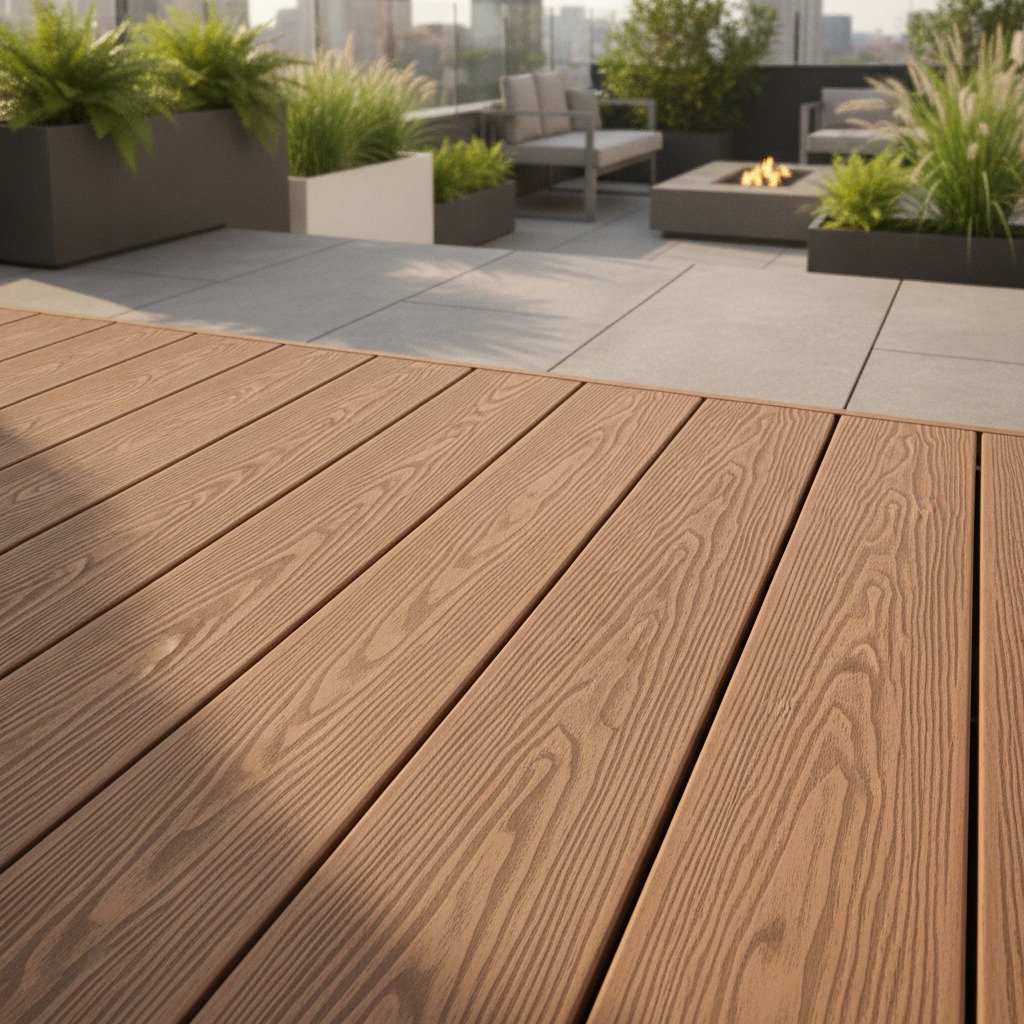
This material is often a strong candidate for residential patios, garden walkways, pool surrounds, roof terraces, and commercial outdoor seating areas. Those are all places where the appearance of wood matters, but repeat maintenance can become expensive or inconvenient. It is also a reasonable option for balcony decking where weight and installation speed matter, provided the supporting structure and local requirements are reviewed.
For cladding or fencing, similar composite profiles may also be used, but buyers should not assume a decking board is automatically right for those uses. Wall applications and floor applications have different exposure patterns, fixing requirements, and aesthetic expectations. A profile that performs well under foot may not be the best choice as a vertical screen panel.
Common mistakes that lead to disappointment
The first mistake is comparing samples only by color. A darker brown board may look richer in a showroom, but color alone tells you very little about surface wear, fading behavior, or field performance. The second mistake is ignoring the substructure. Even a quality board can feel unstable if the joist spacing, drainage path, or edge restraint is poorly planned.
The third mistake is assuming all wood plastic composite decking products are interchangeable. They are not. Profiles vary in core design, wall thickness, surface treatment, and fastening system. Some are optimized for residential use, others for heavier traffic, and some are simply styled to look convincing in a catalog. A buyer who treats them as identical will eventually pay for the shortcut.
One more issue deserves a mention: underestimating how the board will age in the actual site environment. Sun exposure, shade, moisture, airborne grit, and cleaning habits all affect appearance. A board that looks good in dry storage may behave differently near a pool or in a coastal setting. If the supplier cannot explain the board’s intended use conditions in plain language, that is a warning sign.
A practical buying checklist for engineers and sourcing teams
Before placing an order, ask for section drawings, installation guidance, surface finish descriptions, and the exact material declaration if available. Request confirmation of the profile structure, especially if the board is hollow-core. If the project has a high-visibility finish requirement, ask how color consistency is controlled from batch to batch. If traction matters, ask how the surface was designed for wet conditions rather than relying on generic marketing terms.
It is also wise to ask how the boards are intended to be fixed, what accessory components are needed, and whether the supplier has a recommended spacing pattern. Those details often matter more than a dramatic product photo. For larger projects, insist on a small pilot installation or at least a physical sample under the same light and environmental conditions the final deck will face.
FAQ
Is wpc decking the same as wood plastic composite decking?
In practice, yes, the terms are often used interchangeably in the market. The exact formulation and performance can still vary from supplier to supplier, so the label alone is not enough to judge quality.
Is hollow-core always weaker than solid-core?
Not automatically. Hollow-core boards are often lighter and can perform well when installed correctly. The real question is whether the board’s structure, support spacing, and intended use match the project.
Can composite decking replace timber in every project?
No. It is a strong option where low maintenance, visual consistency, and weather resistance are important, but it may not suit every structural, aesthetic, or budget requirement. A timber look is only part of the decision.
What should buyers ask the supplier first?
Ask for the material composition, section drawing, installation system, finish details, and the board’s recommended application. Those five points reveal far more than a polished brochure does.
What a sensible next step looks like
If you are comparing outdoor flooring options right now, do not start with color charts. Start with the structure, the support system, and the maintenance expectation your customer will actually accept. Then judge the look. That sequence is more practical and usually prevents costly rework later.
For teams sourcing wpc decking for a new project, the smartest move is to request full technical information, inspect the board profile closely, and verify that the installation method matches the site conditions. A convincing surface is useful, but it is the internal design and the fit for purpose that decide whether the deck still looks good after the first season, not just on delivery day.